Showing posts with label Non GMO. Show all posts

Tuesday, October 21, 2014

5 Crazy New Reasons Organic Produce Is Really Worth Your Money (and How to Afford It!)


In the quest for a healthier body and a longer life, U.S. consumers are filling their grocery carts with more organic produce than ever, and that number continues to climb every single year. While that’s a great thing for those that can and choose to do so, conventional produce still accounts for a majority of produce sold here in the United States, especially among those who believe organic is too expensive, or who aren’t fully aware of the benefits that come from eating organic foods.

Not all things are 100% necessary to buy organic, such as paper goods and clothing. Even food and beverages labeled certified non-GMO are safer than traditional, conventional foods, even if they aren’t certified organic. However, one area you definitely want to go organic when you can is the produce department. When you’re a vegan, you can luckily avoid having to worry about buying organic meat, poultry, milk, eggs, and dairy (since you may know that organic labeling doesn’t negate the cruelty animals on organic farms go through.) You’ll also save more money by not buying animal products, which will leave you more funds to spend on healthy, organic plant-based items.

Everyone knows that organic foods are beneficial to our  health and the planet,  but do you know exactly why? Here are five reasons to make the switch today:

1. Allergies

Did you know that allergies can arise from consuming non-organic produce? Many people find this is also the case with genetically modified foods. Foods that are directly sprayed with chemicals or that are chemically altered in any way may lead to allergic reactions that can be hard to trace back to your diet. Many people may suspect they have a food allergy, when it could be a chemical in the food instead. The immune system sees chemicals as invaders and sets off an allergic reaction as a result. Buy all organic produce for one week and see how you feel. Be sure to also buy organic pre-packaged foods when you can as well.

2. Gut Microbiome

Pesticides and herbicides contain chemicals that can kill off your beneficial gut bacteria. Low levels of beneficial gut bacteria have been linked to depression, weight gain, diabetes, and yeast overgrowth. Pesticides, antibiotics, and other chemicals sprayed on foods have been shown to change the way the brain and gut work due to the depletion of good gut bacteria. Over time, low gut bacteria and consistent intake of pesticides and chemicals can also lead to leaky gut syndrome, which can cause severe digestive upset and harm.

3. Diabetes

Many chemicals and pesticides have also been linked to poor insulin function, which can cause type 2 diabetes or even mild blood sugar sensitivities. Since everything you eat enters the bloodstream, putting chemicals in your veins doesn’t make a whole lot of sense if you want your hormones such as insulin and leptin that affect your blood sugar, to work their best for you and your health.

4. Animal Safety

One of the most overlooked benefits of buying organic foods is how it actually benefits the animals on farms where organic produce is grown. It’s commonly known that eating organic foods benefits the environment and may help prevent global warming, however, eating organic foods also ensure that animals on these farms or who live nearby these farms aren’t being exposed to harmful pesticides, chemicals, fertilizers, and herbicides.

5. Obesity

It sounds a bit far-fetched to think that you could gain weight from eating conventional produce like celery and bananas, but don’t shake your head at the thought of the idea just yet. The chemicals in non-organic produce and other conventional foods has been shown to create a toxic state within the cells and slow down the metabolism as a result. Considering that our immune system has to work harder to fight off such toxins, it only makes sense that our metabolisms would also slow down.

I know a conventional head of lettuce or shiny red apple might seem harmless enough, but don’t let their appeal fool you. Many are coated with sprays to make them more appealing to consumers, but they actually taste worse than their organic, fresh counterparts. Always go for organic, because if you wouldn’t spray chemicals like Round-up on foods yourself, why would you pay for someone else to?

Feed your body organic, plant-based foods. Want to know how to afford them? Here are some great tips!

1. Buy What’s on Sale

This allows you to rotate what you buy each week and it helps you get in a variety of nutrition. Many stores will cycle when certain organic items go on sale. For example, some rotate the same sale items every four weeks, while some are up to six weeks. Start to pay attention to when items go on sale and you’ll know what to buy when. Or, you can always get friendly with your produce guy (which I highly suggest) and just ask him yourself. Then ask when new trucks are delivered and be sure to get to the store the day the new sale starts and fresh items are delivered. There’s no need to visit multiple stores, but doing so will also give you more exposure to sales.

2. Compare the Cost

Most of the time, organic produce is only a dollar or so more than conventional items. If you can’t afford to buy everything organic, buy what organic foods you can (especially those off the Dirty Dozen list) and eat more of those instead of paying to eat foods filled with chemicals.

Plus, many supermarkets label conventional produce just under the next dollar up in price to make consumers assume they’re much cheaper than organic. For example: conventional apples may be labeled $3.98 per bag or bushel, while organic apples may be $5.28 per bag or bushel. Consumers automatically see the number 3 in the price $3.98 and assume it’s almost $2.00 cheaper, when really, the price difference is only right over $1.25. See what I mean? Don’t let conventional prices fool you! You’re much better paying for a high-quality organic apple free of pesticides and toxins than saving under $2.00 for a bag of less tasty, chemically-treated ones.

3. Shop in Season

It’s also smart to shop in season so you can avoid paying high premiums for items that have to be imported from other countries. Plus, seasonal foods taste fresher, and your body will appreciate you eating in alignment with nature.

4. Don’t Fear Frozen

If you can’t afford organic, fresh spinach, berries, etc., then go with organic frozen items. They might not be as tasty, but frozen foods are possibly just as nutritious (if not fresher) than non-frozen items since they’re frozen at peak harvest. They also last longer, which means you won’t be throwing anything away. Learn how to freeze your own bounty.

5. Re-evaluate Your Priorities

When I started seeing the benefits in my own health from eating organic, plant-based foods, I made sacrifices in other areas of my life so I could afford to do so. Did I really need those magazine subscriptions every month? Was that new shirt each week really more important than feeding my body clean, natural foods? See where you can spare $10.00-$20.00 or so per week, and then spend that money on organic produce versus opting for conventional items.


Monday, October 28, 2013

8 Foods Even The Experts Won’t Eat


Food scientists are shedding light on items loaded with toxins and chemicals–and simple swaps for a cleaner diet and supersized health. Experts from different areas of specialty explain why they won’t eat these eight foods.

Clean eating means choosing fruits, vegetables, and meats that are raised, grown, and sold with minimal processing. Often they’re organic, and rarely (if ever) should they contain additives. But in some cases, the methods of today’s food producers are neither clean nor sustainable. The result is damage to our health, the environment, or both. So we decided to take a fresh look at food through the eyes of the people who spend their lives uncovering what’s safe–or not–to eat. ” Their answers don’t necessarily make up a “banned foods” list. But reaching for the suggested alternatives might bring you better health–and peace of mind.

1. The Endocrinologist Won’t Eat: Canned Tomatoes

Fredrick Vom Saal, is an endocrinologist at the University of Missouri who studies bisphenol-A.

The problem
: The resin linings of tin cans contain bisphenol-A, a synthetic estrogen that has been linked to ailments ranging from reproductive problems to heart disease, diabetes, and obesity. Unfortunately, acidity (a prominent characteristic of tomatoes) causes BPA to leach into your food. Studies show that the BPA in most people’s body exceeds the amount that suppresses sperm production or causes chromosomal damage to the eggs of animals. “You can get 50 mcg of BPA per liter out of a tomato can, and that’s a level that is going to impact people, particularly the young,” says vom Saal. “I won’t go near canned tomatoes.”

The solution: Choose tomatoes in glass bottles (which do not need resin linings), such as the brands Bionaturae and Coluccio. You can also get several types in Tetra Pak boxes, like Trader Joe’s and Pomi. Exposure to BPA Causes Permanent Damage In OffSpring

2. The Farmer Won’t Eat: Corn-Fed Beef

Joel Salatin is co-owner of Polyface Farms and author of half a dozen books on sustainable farming.

The problem: Cattle evolved to eat grass, not grains. But farmers today feed their animals corn and soybeans, which fatten up the animals faster for slaughter. But more money for cattle farmers (and lower prices at the grocery store) means a lot less nutrition for us. A recent comprehensive study conducted by the USDA and researchers from Clemson University found that compared with corn-fed beef, grass-fed beef is higher in beta-carotene, vitamin E, omega-3s, conjugated linoleic acid (CLA), calcium, magnesium, and potassium; lower in inflammatory omega-6s; and lower in saturated fats that have been linked to heart disease. “We need to respect the fact that cows are herbivores, and that does not mean feeding them corn and chicken manure,” says Salatin.

The solution: Buy grass-fed beef, which can be found at specialty grocers, farmers markets, and nationally at Whole Foods. It’s usually labeled because it demands a premium, but if you don’t see it, ask your butcher.

3. The Toxicologist Won’t Eat: Microwave Popcorn

Olga Naidenko, is a senior scientist for the Environmental Working Group.

The problem: Chemicals, including perfluorooctanoic acid (PFOA), in the lining of the bag, are part of a class of compounds that may be linked to infertility in humans, according to a recent study from UCLA. In animal testing, the chemicals cause liver, testicular, and pancreatic cancer. Studies show that microwaving causes the chemicals to vaporize–and migrate into your popcorn. “They stay in your body for years and accumulate there,” says Naidenko, which is why researchers worry that levels in humans could approach the amounts causing cancers in laboratory animals. DuPont and other manufacturers have promised to phase out PFOA by 2015 under a voluntary EPA plan, but millions of bags of popcorn will be sold between now and then.

The solution: Pop organic kernels the old-fashioned way: in a skillet. For flavorings, you can add real butter or dried seasonings, such as dillweed, vegetable flakes, or soup mix. Make it organic and use coconut oil. If You’re Still Eating Microwave Popcorn, You’re Not Fully Grasping The Health Consequences

4. The Farm Director Won’t Eat: Non-Organic Potatoes

Jeffrey Moyer is the chair of the National Organic Standards Board.

The problem: Root vegetables absorb herbicides, pesticides, and fungicides that wind up in soil. In the case of potatoes–the nation’s most popular vegetable–they’re treated with fungicides during the growing season, then sprayed with herbicides to kill off the fibrous vines before harvesting. After they’re dug up, the potatoes are treated yet again to prevent them from sprouting. “Try this experiment: Buy a conventional potato in a store, and try to get it to sprout. It won’t,” says Moyer, who is also farm director of the Rodale Institute (also owned by Rodale Inc., the publisher of Prevention). “I’ve talked with potato growers who say point-blank they would never eat the potatoes they sell. They have separate plots where they grow potatoes for themselves without all the chemicals.”

The solution: Buy organic potatoes. Washing isn’t good enough if you’re trying to remove chemicals that have been absorbed into the flesh.  Budget tip: Organic potatoes are only $1 to $2 a pound, slightly more expensive than conventional spuds.

5. The Fisheries Expert Won’t Eat: Farmed Salmon

Dr. David Carpenter, director of the Institute for Health and the Environment at the University at Albany, published a major study in the journal Science on contamination in fish.

The problem: Nature didn’t intend for salmon to be crammed into pens and fed soy, poultry litter, and hydrolyzed chicken feathers. As a result, farmed salmon is lower in vitamin D and higher in contaminants, including carcinogens, PCBs, brominated flame retardants, and pesticides such as dioxin and DDT. According to Carpenter, the most contaminated fish come from Northern Europe, which can be found on American menus. “You could eat one of these salmon dinners every 5 months without increasing your risk of cancer,” says Carpenter, whose 2004 fish contamination study got broad media attention. “It’s that bad.” Preliminary science has also linked DDT to diabetes and obesity, but some nutritionists believe the benefits of omega-3s outweigh the risks. There is also concern about the high level of antibiotics and pesticides used to treat these fish. When you eat farmed salmon, you get dosed with the same drugs and chemicals.

The solution: Switch to wild-caught Alaska salmon. If the package says fresh Atlantic, it’s farmed. There are no commercial fisheries left for wild Atlantic salmon.

6. The Cancer Researcher Won’t Drink: Milk Produced With Artificial Hormones

Rick North is project director of the Campaign for Safe Food at the Oregon Physicians for Social Responsibility and former CEO of the Oregon division of the American Cancer Society.

The problem: Milk producers treat their dairy cattle with recombinant bovine growth hormone (rBGH or rBST, as it is also known) to boost milk production. But rBGH also increases udder infections and even pus in the milk. It also leads to higher levels of a hormone called insulin-like growth factor in milk. In people, high levels of IGF-1 may contribute to breast, prostate, and colon cancers. “When the government approved rBGH, it was thought that IGF-1 from milk would be broken down in the human digestive tract,” says North. “There’s not 100 percent proof that this is increasing cancer in humans,” admits North. “However, it’s banned in most industrialized countries.”

The solution: Buy raw milk or check labels for rBGH-free, rBST-free, produced without artificial hormones, or organic milk. These phrases indicate rBGH-free products. The Sour Facts About Milk.

7. The Biotech Specialist Who Won’t Eat Conventional Soy: GMO Unfermented Soy

Michael Harris is biotech specialist who has directed several projects within the biotech sector including those for genetically engineered food. He has been a consultant, manager and director for companies such as Xenon Pharmaceuticals and Genon Corporation.

The problem: Genetically engineered food is a cause of great concern due to the manipulation of DNA and genetic code including transfers from one species to another. Fermented soy is the only soy food fit for human consumption and since almost 90% of soy in the world is genetically modified, if you are not ensuring sources are organic, long-term health problems are inevitable, especially since soy has been found to affect hormonal balance and even cause cancer.

The solution: Check labels to ensure soy is Non-GMO or organic and never consume unfermented sources. If possible contact the company to find out exactly where the Non-GMO soy was obtained.

8. The Organic-Foods Expert Won’t Eat: Conventional Apples

Mark Kastel, a former executive for agribusiness, is co-director of the Cornucopia Institute, a farm-policy research group that supports organic foods.

The problem: If fall fruits held a “most doused in pesticides contest,” apples would win. Why? They are individually grafted (descended from a single tree) so that each variety maintains its distinctive flavor. As such, apples don’t develop resistance to pests and are sprayed frequently. The industry maintains that these residues are not harmful. But Kastel counters that it’s just common sense to minimize exposure by avoiding the most doused produce, like apples. “Farm workers have higher rates of many cancers,” he says. And increasing numbers of studies are starting to link a higher body burden of pesticides (from all sources) with Parkinson’s disease.

The solution: Buy organic apples or apples from a farmer that you trust!

Thursday, April 11, 2013

Why GMO Labeling Won't Cost Consumers a Dime


By Zack Kaldveer and Ronnie Cummins
Organic Consumers Association, April 9, 2013

The biotech industry, led by Monsanto, will soon descend on the state of Washington to try their best to defeat I-522, a citizens’ ballot initiative to require mandatory labeling of foods that contain genetically engineered (GE) ingredients. Voters should prepare themselves for an onslaught of discredited talking points, nonsensical red herrings, and outright lies designed to convince voters that they shouldn’t have the right to know what’s in the food they eat.

Topping the biotech industry’s propaganda playlist will no doubt be this old familiar tune: that requiring retailers to verify non-GMO ingredients in order to label them will be burdensome and costly, and the additional cost will be passed on to consumers who are already struggling to feed their families.

Playing to consumers’ fears of higher food costs makes good strategic sense, especially in tough economic times. But the argument doesn’t hold water, say food manufacturers and retailers who already have systems in place for verifying non-GMO, as well as rBGH-free, trans fat-free, country of origin and fair trade. The system involves using chain-of-custody, legally binding affidavits, not expensive testing.

“We have used the affidavit system repeatedly, without undue burden or cost,” said Trudy Bialic, Director of Public Affairs for Seattle-based PCC Natural Markets. PCC, the largest consumer-owned natural food retail co-operative in the United States, uses the affidavit system to ensure their chocolate isn't made using child slave labor, their dairy products don't come from animals subjected to rBGH hormones, and that all seafood was harvested using sustainable sources and practices.

Trader Joe’s, a privately held chain of nearly 400 U.S. stores, confirmed that the company’s private label products, under the names Trader Joe’s, Jose’s and Ming’s, are GMO-free, though the company doesn’t label them as such. In an email, a company spokesperson said:

" When developing products containing ingredients likely to come from genetically modified sources, we have the supplier of the product in question perform the necessary research to provide documentation that the suspect ingredients are from non-GMO sources.

This documentation is in the form of affidavits, identity-preserved certification of seed stock, and third-party lab results from testing of the ingredients in question."

Trader Joe’s performs random audits of items with suspect ingredients, using an outside, third-party lab to perform the testing, the company said. Trader Joe’s system is not unlike that of the USDA, which requires sworn statements from food producers to certify organic foods. The agency requires test samples from approximately 5 percent of products, all of which must be GMO-free in order to be certified organic. For the other 95 percent, the agency relies solely on sworn statements.

Clif Bar & Co. also requires affidavits from ingredient suppliers demonstrating they can meet the company's stringent non-GMO requirements.

Monsanto would have you believe that verifying and labeling for non-GMO ingredients is a costly and burdensome affair, but the fact that Trader Joe’s, known for its discount prices, can provide GMO-free private label products, which reportedly account for over two-thirds of the company’s estimated annual $9 billion in sales, takes the wind out of the “burdensome” argument. That leaves the cost of adding another line of ink to a label. Trader Joe’s doesn’t yet label its private label products as GMO- free, but the company cites a lack of clear labeling guidelines from U.S. governmental agencies as the reason it doesn’t label, not cost.

Megan Westgate, Executive Director of the Non-GMO Project confirmed what retailers who use the affidavit system said: "An affidavit system like what's proposed in I-522 is a powerful way to have a significant impact on the food supply with minimal cost."

How does the affidavit system work?

Companies selling non-GMO foods provide a sworn statement (i.e. an affidavit) to the retailer that the ingredients used are sourced from crops that aren’t intentionally genetically engineered. The affidavit, unless deliberately dishonest, protects the manufacturer and the retailer from liability in the case of unintentional GMO contamination.

Retailers are responsible only for labeling a few raw commodities that may contain GE ingredients, such as sweet corn, papaya, or squash. In these cases, the retailer can either stick a simple label on the bin or ask their supplier for an affidavit stating that the crop is GMO free.

Under this system, no costly testing for GE ingredients is required. No burdensome government oversight is necessary. The system is inherently designed to protect small grocers and retailers, at no additional cost to the customer or taxpayer.

The beauty of the affidavit system is that it offers retailers and manufacturers a simple, easy way to comply with a regulatory model that provides consumers with the right to know what’s in their food without increasing grocery costs. Even for manufacturers who might otherwise seek to pass on the trivial expense of relabeling to consumers, empirical studies show that the fear of losing customers in the competitive food industry will be a deterrent to raising prices. Did food costs change when we labeled calorie content?

Is the system reliable? Retailers say yes. Why would manufacturers intentionally deceive retailers only to open themselves up to a lawsuit and public relations nightmare? And the system has a proven track record. PCC Natural Markets, Trader Joe’s and Clif Bar all use affidavits, as do other manufacturers who use them for country-of-origin and no-trans fat labeling. And nearly two-thirds of the nation’s largest dairy processors use sworn affidavits from producers in order to label rBGH-free. (rBGH, or recombinant bovine growth hormone, is a synthetic, genetically engineered hormone injected into dairy cows to increase milk production).

Contrary to claims made by companies like Monsanto, states do have a constitutional right to label food. In fact, the Food, Drug and Cosmetic Act explicitly allows states to add language to labels so long as the federal government doesn’t require language on the same subject – a right that has consistently held up in federal court.

A chain-of-custody, legally binding affidavit labeling system empowers consumers to make more informed choices about what we eat, without increasing the costs of groceries or burdening retailers and manufacturers. One simple label to identify foods that have been genetically engineered, often using the genes of foreign bacteria and viruses, would lead more consumers to seek out sustainable, organic, non-GMO alternatives. And that – not some phony line about increased food costs – is why Monsanto is fighting labeling.

Zack Kaldveer is assistant media director at the Organic Consumers Association.

Ronnie Cummins is founder and director of the Organic Consumers Association. Cummins is author of numerous articles and books, including "Genetically Engineered Food: A Self-Defense Guide for Consumers" (Second Revised Edition Marlowe & Company 2004). 

Monday, April 8, 2013

8 in 10 parents buy organic

ORGANIC TRADE ASSOCIATION 


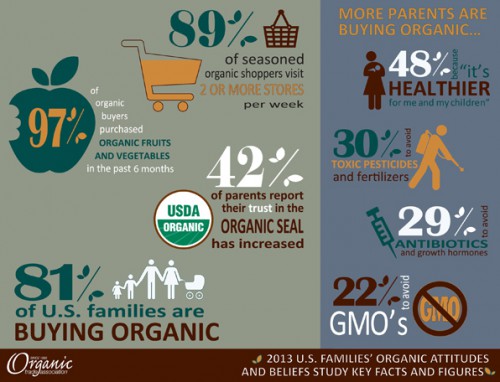
U.S. families are increasingly embracing organic products in a wide range of categories, with 81 percent now reporting they purchase organic at least sometimes. This finding is one of many contained in the Organic Trade Association’s (OTA’s) newly released 2013 U.S. Families’ Organic Attitudes and Beliefs Study, conducted Jan. 18 to 24, 2013.

 “More and more parents choose organic foods primarily because of their desire to provide healthful options for their children,” said Christine Bushway, OTA’s CEO and executive director.

Not only are more consumers choosing organic products at least sometimes, but the majority of those buying organic foods are purchasing more items than a year earlier. New entrants to buying organic now represent 41 percent of all families—demonstrating interest in the benefits of organic food and farming is on the rise.

Produce continues to be the leading category of organic purchases, with 97 percent of organic buyers saying they had purchased organic fruits or vegetables in the past six months. Breads and grains, dairy and packaged foods were also frequently cited (all scoring above 85 percent) among those who purchase organic. Families choosing organic foods are increasingly important to retailers of all types, with organic buyers reporting spending more per shopping trip, and shopping more frequently than those who never purchase organic food.

Consistent with findings from previous studies, nearly half (48 percent) of those who purchase organic foods said they do so because they are “healthier for me and my children.” Additionally, parents’ desire to avoid toxic and persistent pesticides and fertilizers (30 percent), antibiotics and growth hormones (29 percent), and genetically modified organisms (22 percent) ranked high among the reasons cited for buying organic products.

Awareness of the USDA Organic seal has also grown, with more consumers more likely to look for the seal when shopping for organic products. Moreover, over 4 in 10 parents (42 percent) say their trust in organic products has increased, versus 32 percent who indicated this point of view a year ago. In fact, younger, new-to-organic parents are significantly more likely to report improved levels of trust in organic products.

“Consumer trust is on the upswing for organic as the gold standard when seeking to avoid toxic and persistent pesticides, antibiotics, synthetic hormones, genetically engineered ingredients, and additives,” Bushway added.

Study findings, gathered in partnership with KIWI Magazine, are based on responses from 1,239 U.S. households about their attitudes and behaviors related to organic foods. The report provides in-depth information about organic consumers’ demographics, purchase motivation, labeling comprehension, shopping patterns, and more.

The 2013 U.S. Families’ Organic Attitudes and Beliefs Study is available for purchase.

Monday, November 5, 2012

Hidden GMOs in Packaged Food

 
Grab any packaged food in your pantry and read the label. The following are ingredients that may contain GMOs, unless certified organic or non-GMO.

Aspartame (also called AminoSweet®,    NutraSweet®, Equal Spoonful®, Canderel®,  BeneVia®, E951)
baking powder
canola oil (rapeseed oil)
caramel color
cellulose
citric acid
cobalamin (Vitamin B12)
colorose
condensed milk
confectioners sugar
corn flour
corn masa
corn meal
corn oil
corn sugar
corn syrup
cornstarch
cottonseed oil
cyclodextrin
cystein
dextrin
dextrose
diacetyl
diglyceride
erythritol
Equal
food starch
fructose (any form)
glucose
glutamate
glutamic acid
glycerides
glycerin
glycerol
glycerol monooleate
glycine
hemicellulose
high fructose corn syrup (HFCS)
hydrogenated starch
hydrolyzed vegetable protein
inositol
inverse syrup
inversol
invert sugar
isoflavones
lactic acid
lecithin
leucine
lysine
malitol
malt
malt syrup
malt extract
maltodextrin
maltose
mannitol
methylcellulose
milk powder
milo starch
modified food starch
modified starch
mono and diglycerides
monosodium glutamate (MSG)
Nutrasweet
oleic acid
Phenylalanine
phytic acid
protein isolate
shoyu
sorbitol
soy flour
soy isolates
soy lecithin
soy milk
soy oil
soy protein
soy protein isolate
soy sauce
starch
stearic acid
sugar (unless specified as cane sugar)
tamari
tempeh
teriyaki marinades
textured vegetable protein
threonine
tocopherols (vitamin E)
tofu
trehalose
triglyceride
vegetable fat
vegetable oil
vitamin B12
vitamin E
whey
whey powder
xanthan gum
Vitamin C (ascorbic acid) although usually derived from corn, is probably not GM because it is not likely made in North America.

Monday, October 1, 2012

My Favorite Pumpkin Pie Recipe

Happy October 1st! 
As summer gives way to the harvest season, I notice many surprises, especially when shopping. As I walk into the grocery store I quickly notice, they have pumpkins! I get really excited cause really, this is the only time my family and I make my favorite pumpkin pie...and I thought this would be the perfect opportunity to share it all with you! I hope you all will enjoy this as much as I do!

For the Crust, You will Need:
1/4 Cup Melted Butter
1 1/4 Cups Crushed Gingersnap Cookies

Mix those together and press into a 9-inch pie pan and bake for 10 minutes at 325ยบ.


For the Filling, You will Need:
Blend 1 Tablespoon Gelatin with 1/4 Cup Cold Water and set aside.

Mix Together in a Saucepan:
3/4 Cup Brown Sugar
1/2 teaspoon Salt
2 teaspoon Cinnamon
1/2 teaspoon Ginger
1/2 teaspoon Allspice
1 1/3 Cups Mashed Cooked Pumpkin
3 Large Egg Yolks
1/2 Cup Milk

Meringue:
3 Large Egg Whites
1/4 teaspoon Cream of Tartar
6 Tablespoons Sugar

Cook over low heat stirring until the mixture boils. Boil 1 minute. remove from heat. Stir in the gelatin. Cool. When partially set, beat until smooth. Carefully fold in the meringue. Pile into the ginger cookie crust. Chill until set, about 2 hours. Garnish with fresh whipped cream.

Looking for more great pumpkin recipes?! Check out Taste Of Home's 'Top 10 Pumpkin Dessert Recipes'