Showing posts with label United States. Show all posts

Thursday, December 5, 2013

Designer Genes: The 7 Most Common Genetically Modified Foods

Genetically modified material sounds a little bit like science fiction territory, but in reality, much of what we eat on a daily basis is a genetically modified organism (GMO). Whether or not these modified foods are actually healthy is still up for debate -- and many times, you don't even know that you are buying something genetically modified.

It is not required to label GMOs in the U.S. and Canada, but there are substantial restrictions, and even outright bans, on GMOs in many other countries.

However, by 2018, Whole Foods Market will start labeling GMOs in the U.S. This grocery chains' locations in Britain already provide GMO labeled products, as required by the European Union. According to the EU, GMO refers to plants and animals"in which the genetic material has been altered in a way that does not occur naturally by mating and/or natural recombination."

1. Corn

Almost 85 percent of corn grown in the U.S. is genetically modified. Even Whole Foods's brand of corn flakes was found to contain genetically modified corn. Many producers modify corn and soy so they are resistant to the herbicide glyphosate, which is used to kill weeds.

2. Soy

Soy is the most heavily genetically modified food in the country. The largest U.S. producer of hybrid seeds for agriculture, Pioneer Hi-Bred International, created a genetically engineered soybean, which was approved in 2010. It is modified to have a high level of oleic acid, which is naturally found in olive oil. Oleic acid is a monounsaturated omega-9 fatty acid that may lower LDL cholesterol (traditionally thought of as "bad" cholesterol) when used to replace other fats.

3. Yellow Crookneck Squash and Zucchini

Numbers of this GMO veggie are relatively small, but genetically modified yellow squash and zucchini can be found in two different species in the U.S. The species contain protein genes that protect against viruses. Just like their other GMO counterparts, you won't be able to tell the difference between non-GMO and GMO zucchini or squash.

4. Alfalfa

Cultivation of genetically engineered alfalfa was approved in 2011, and consists of a gene that makes it resistant to the herbicide Roundup, allowing farmers to spray the chemical without damaging the alfalfa.

5. Canola

Canola is genetically engineered form was approved in 1996, and as of 2006, around 90 percent of U.S. canola crops are genetically modified.

6. Sugar Beets

A very controversial vegetable, sugar beets were approved in 2005, banned in 2010, then officially deregulated in 2012. Genetically modified sugar beets make up half of the U.S. sugar production, and 95 percent of the country's sugar beet market.

7. Milk

To increase the quantity of milk produced, cows are often given rBGH (recombinant bovine growth hormone), which is also banned in the European Union, as well as in Japan, Canada, New Zealand and Australia.

Looking Forward: Do GMO Apples Give Us A Glimpse Of The Future?

GMO apples are currently under review by the USDA, and have been since 2010, when the company Okanagan Specialty Fruits, Inc., developed apple varieties that don't turn brown for an entire two weeks after slicing.

Polyphenol oxidase (PPO) is an enzyme that causes the browning of Golden Delicious and Granny Smith apples, and scientists are now able to deactivate the gene. Some studies do show stripping fruits of PPO can impact a plant's susceptibility to diseases. The creators say they simply want people to eat more apples and while activating this gene slows the process of browning, it's still a natural process.

It's clear that other parts of the world view GMOs as health threats, but it's still an ongoing debate here in America. For now, many GMOs have been deemed safe by organizations like the Food and Drug Administration and the U.S. Department of Agriculture.

Tuesday, August 20, 2013

Who wouldn't want GMO labeling in the U.S.?


One thing true about the GMO movement is that not everyone is convinced genetically modified food is dangerous or bad to eat. It's important, though, to keep the scope of the question in focus.

We are not debating whether GM food is good or bad.

What we are debating is whether American consumers have a right to know the GM status of the food they put in their bodies.


Why then, in this nation of "transparency" and "individual freedom," does there seem to be something out there that wants to keep grocery stores' doors as frosted and opaque as possible? Who wouldn't want consumers to know—that they might make their own decision?

Dave Murphy, executive director of Food Democracy Now!, a grassroots movement of more than 650,000 farmers and citizens, offers a somewhat sobering answer to that question. Upon hearing that major food producers were meeting to discuss GMO labeling at the Grocery Manufacturers Association (GMA) in Washington in mid-July, he offered this in a press release widely circulated around Facebook:

“American consumers have a right to know what’s in their food, and it's time that Monsanto and the GMA stop hiding those facts and America’s large food manufacturers endorse the labeling of genetically engineered foods.

Polls have consistently shown that more than 90 percent of Americans support GMO labeling. It’s time for the hypocrisy on genetically engineered foods to end in the land of the free and the home of the brave and we urge the Grocery Manufacturers Association to stop opposing GMO-labeling nationwide.”

—Dave Murphy, executive director of Food Democracy Now!
NewHope360.com caught up with Murphy after the meeting and asked him what he thought the results of the conference were, and what would happen next. Here is what he said:

"The Grocery Manufacturers Association is moving forward with their efforts to kill GMO labeling in the U.S.," Murphy said. "Rather than heed the calls of millions of American consumers to offer basic transparency in the market place, the GMA is encouraging their members to spend millions of dollars to defeat a citizen-led ballot initiative in Washington state, like they did with Prop 37 in California."

Officially at least, big biotech companies like Monsanto are promising to be more transparent. As The New York Times reported on July 28, companies are pledging to create a website that will answer "virtually any question posed by consumers about genetically engineered crops."

The site, GMOAnswers.com, will be run by the Council for Biotechnology Information, which includes Dow Chemical, DuPont, Syngenta, Bayer CropScience and BASF.

According to the Times, most of the corn, soybeans, cotton, canola and sugar beets grown in the United States contain bacterial genes that make the crops resistant to an herbicide, insects or both. The Food and Drug Administration has said that such genetic engineering does not make these foods materially different in a way that would require labeling.

To anti-GMO activists, this is not enough. In May, thousands of people in cities around the world "marched against Monsanto" and against GMO-friendly laws. Dave Murphy, the leader of Food Democracy Now! believes change will first have to come at the state level. In a quick sit-down, this is what he had to say:

newhope360: What is at risk for food manufacturing companies?

Dave Murphy: By joining with the likes of pesticide and biotech companies such as Monsanto, DuPont and Syngenta, food companies like Coca-Cola, Pepsi, Kraft, Kellogg’s and General Mills are jeopardizing the future of their brands as millions of Americans wake up to the fact these companies have willfully spent millions of dollars to deceive them about the contents in their food and deny them their basic democratic rights.

Any food company that does not support mandatory state and federal labeling of genetically engineered foods is increasingly placing their brand at risk of public exposure. If they want to deny us our rights, we will deny them their profits.

newhope360: What comes next in this battle or debate?

DM: Right now, activists across the country are working to pass Washington state's Yes on 522 ballot initiative to label GMOs, and follow up on the successes in Connecticut and Maine with bills in more than 20 other states.

Labeling of genetically engineered food is going to happen in the U.S.; this movement is not going away until we have a strong national GMO labeling bill. Giant food companies and politicians have to ask themselves if they're willing to risk their profits, reputations and careers to protect an industry that already labels food products with every major U.S. trading partner.

It's time for America to join the rest of the civilized world and allow reasonable and common sense GMO labeling bills to become the law of the land.

Who is padding the pockets of the Grocery Manufacturers Association?

  • In 2012, Monsanto was the top contributor to the GMA’s campaign to defeat GMO labeling and Prop 37 last year, contributing over $8.1 million dollars in 2012.
  • Other top contributors include Pepsi Co. at $2.48 million dollars in 2012.
  • Kraft Foods at $2 million dollars in 2012.
  • Coca-Cola at $1.7 million dollars in 2012.
  • This year, 26 states have introduced legislation to label genetically engineered foods, with GMO labeling bills recently passing in Connecticut and Maine.
  • A GMO labeling bill also passed the Vermont House this spring and awaits passage as early as next January in the Vermont Senate.
  • Similar legislation has been introduced in Massachusetts, Minnesota, New Jersey and Pennsylvania. Monsanto and the GMA have expressed fears over the passage of the upcoming ballot initiative in Washington State this fall, similar to the one in California, which places the issue of labeling genetically engineered foods before a popular statewide vote.
-- Statistics by Food Democracy Now!

Friday, July 12, 2013

Why to Support Labeling GM Foods

Many U.S. states have mandatory labeling of genetically modified foods on their legislative agendas. Survey after survey shows that more than 90 percent of us want GM foods to be labeled. Now is the time to contact your elected representatives and let them know you’re concerned about genetically modified food.


Genes form the building blocks of all life. Genetic modification — the technological shuffling of those building blocks among unrelated species — has been heralded since the 1990s as a potentially powerful agricultural tool. But pretty much all the genetically modified (GM) foods that have come to market so far have been crop varieties engineered to resist herbicides or produce insecticidal compounds (so farmers could, theoretically, apply fewer chemicals), and milk from dairy cows given a GM growth hormone that forces them to give more milk. Some countries have adopted these products, but others have banned them because the actual benefits of GM varieties remain unclear, especially as pests adapt to the traits upon which the technology relies.

Both benefits and downsides for consumers are controversial. In 1992, the U.S. Food and Drug Administration ruled, based on woefully limited data, that GM foods were “substantially equivalent” to their non-GM counterparts. That ruling has been under fire ever since, but the government has failed to require new safety testing. Meanwhile, thousands of foods containing GM corn and soy have been introduced into our food supply (see the chart at How to Avoid Genetically Modified Food to learn how to avoid GM foods).

Recent studies have escalated public concern and renewed demands that GM foods be labeled. Studies have linked genetically modified organisms (GMOs) to cancer, deterioration of liver and kidney function, stomach inflammation, and impaired embryonic development.

Whether you’re for or against GM foods, one thing’s for certain: The science is incomplete.

A GMO labeling initiative on the 2012 ballot in California failed by 53 to 47 percent. Proponents of labeling spent $7.3 million; Big Ag and food processors spent $44 million. Labeling GM foods is about much more than just food safety. It’s about our right as consumers to know what we are eating. But labeling is also about how dominant we are going to allow Big Ag to become. Some of us don’t want to eat GM foods or feed them to our livestock. Others push for labeling because we want to make sure our food policy isn’t set by a handful of multinational corporations.

In the United States, we expect food to carry a label that tells us what’s in it. We require that our orange juice reveal if it is made directly from oranges or “from concentrate.” We require labels to tell us if salt, sugar, MSG, artificial flavors or colors, vitamins, or other ingredients have been added. We require meat labels to reveal when it has been pumped with up to a 12 percent saltwater “flavor solution.” And we require milk to indicate whether it is skim, 1 percent fat, 2 percent fat or whole. GM foods should be labeled; there is simply no good argument against telling consumers the whole story.

Monsanto and big food companies like to claim that genetic engineering is essential to feed the world’s ever-growing population. That’s nonsense — most hunger is due to economic inequality and systemic corruption that prevents food from getting to where it’s needed, not due to food shortages. And on the note of the “world’s ever-growing population,” it’s time for society to recognize that unlimited population growth is not sustainable to begin with. We need to choose a wiser course.

Survey after survey shows that 90 percent or more of us want GM foods to be labeled. The GMO-labeling initiative in California almost passed last year, despite the oceans of money pouring in to defeat it. Nearly half of U.S. states now have mandatory GM labeling on their legislative agendas.

If you’re concerned about labeling GM foods, now is the time to contact your elected representatives.

Friday, May 3, 2013

HerbDay 2013 set for May 4


The eighth annual HerbDay, an event sponsored by the HerbDay Coalition, which includes the American Herbal Products Association (AHPA), is set for Saturday, May 4. HerbDay is an internationally coordinated series of independently produced, public, educational events celebrating the importance of herbs and herbalism.

HerbDay was conceived to raise awareness of the significance of herbs and the many ways they can be used safely and creatively for health, beauty, and culinary enjoyment. Greater familiarity with herbs will increase informed use of herbal products and build public support for maintaining personal choice in the use of botanicals.

AHPA encourages the herb and botanical products industry to support and participate in this national day that provides an inexpensive marketing and branding opportunity for companies that market these products to consumers.

Self-directed events across the country have attracted the participation of herbalists and health care providers, authors, teachers, herbal products manufacturers and marketers, schools, organizations, media, retailers, botanical gardens, healthcare professionals and community organizations.

The volunteer-based HerbDay Coalition, consisting of the American Botanical Council, United Plant Savers, AHPA, the American Herbal Pharmacopoeia, and the American Herbalists Guild, hopes you will join it as a participant in the 2013 HerbDay and in its efforts to foster future events.

Attend a HerbDay Event near you!! Happy HerbDay!

[via NewHope 360] 

Monday, April 8, 2013

8 in 10 parents buy organic

ORGANIC TRADE ASSOCIATION 


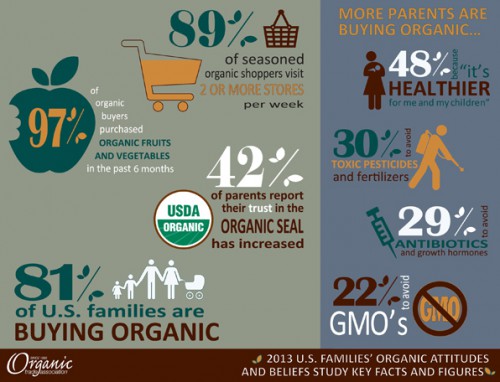
U.S. families are increasingly embracing organic products in a wide range of categories, with 81 percent now reporting they purchase organic at least sometimes. This finding is one of many contained in the Organic Trade Association’s (OTA’s) newly released 2013 U.S. Families’ Organic Attitudes and Beliefs Study, conducted Jan. 18 to 24, 2013.

 “More and more parents choose organic foods primarily because of their desire to provide healthful options for their children,” said Christine Bushway, OTA’s CEO and executive director.

Not only are more consumers choosing organic products at least sometimes, but the majority of those buying organic foods are purchasing more items than a year earlier. New entrants to buying organic now represent 41 percent of all families—demonstrating interest in the benefits of organic food and farming is on the rise.

Produce continues to be the leading category of organic purchases, with 97 percent of organic buyers saying they had purchased organic fruits or vegetables in the past six months. Breads and grains, dairy and packaged foods were also frequently cited (all scoring above 85 percent) among those who purchase organic. Families choosing organic foods are increasingly important to retailers of all types, with organic buyers reporting spending more per shopping trip, and shopping more frequently than those who never purchase organic food.

Consistent with findings from previous studies, nearly half (48 percent) of those who purchase organic foods said they do so because they are “healthier for me and my children.” Additionally, parents’ desire to avoid toxic and persistent pesticides and fertilizers (30 percent), antibiotics and growth hormones (29 percent), and genetically modified organisms (22 percent) ranked high among the reasons cited for buying organic products.

Awareness of the USDA Organic seal has also grown, with more consumers more likely to look for the seal when shopping for organic products. Moreover, over 4 in 10 parents (42 percent) say their trust in organic products has increased, versus 32 percent who indicated this point of view a year ago. In fact, younger, new-to-organic parents are significantly more likely to report improved levels of trust in organic products.

“Consumer trust is on the upswing for organic as the gold standard when seeking to avoid toxic and persistent pesticides, antibiotics, synthetic hormones, genetically engineered ingredients, and additives,” Bushway added.

Study findings, gathered in partnership with KIWI Magazine, are based on responses from 1,239 U.S. households about their attitudes and behaviors related to organic foods. The report provides in-depth information about organic consumers’ demographics, purchase motivation, labeling comprehension, shopping patterns, and more.

The 2013 U.S. Families’ Organic Attitudes and Beliefs Study is available for purchase.

Monday, April 1, 2013

National Farmworker Awareness Week highlights a dirty labor plight

This week it’s time to pay some respect to the folks who actually do most of that farming work.


The vast majority of our stateside fruits and vegetables are handpicked by more than 3 million migrant and seasonal farmworkers. Without those farmworkers, we’d be very hungry. But as a whole those workers are treated badly: They’re underpaid, underinsured, and undereducated. About half of them are undocumented, and only about a third are U.S. citizens. These workers bear the brunt of our food system with their bodies, but only California requires that they get water and bathroom breaks. On average, one farmworker dies on the job every day in the U.S., and laborers can be as young as 12 — legally.


[via: Grist]

Thursday, February 7, 2013

Statewide GMO Labeling Initiatives Still Going Strong


After the pledge to avoid products containing GMOs was denied when California’s Proposition 37 failed to pass during the election last November, it has had little affect on the anti-GMO movement. And with talks of the FDA approving genetically engineered salmon on its way, Americans are increasingly in favor of more food labeling with an overwhelming percent of Democrats, Independants and Republicans in favor, according to the National Survey of Healthcare Consumers: Genetically Engineered Food published on Just Label It!.
For more than 10 years, processed foods in the U.S. are made from genetically modified crops manipulated in laboratories. A movement to eliminate such ingredients in food has brought about awareness and posed questions regarding the negative effects of biotechnology on human health and the environment. While some scientists say GMO doesn’t pose a threat to either, many state-initiatives bills and campaigns continue to try and reach legislation in an effort to mandate labeling at the federal level.
Washington and New Mexico are just two of the 30 states that are gaining ground on their current initiative to mandate labeling. But, with most of the remaining states also behind the movement through proposed bills and campaigns, the anti-GMO movement is far from over.
Arizona—GMO-Free Phoenix is a food activist group working to educate consumers on safe ingredients and increase the Non-GMO Tipping Point Network to see that the genetically modified foods and brands are put out of business.
California— While the majority voted against Prop. 37 in recent elections, the Right to Know campaign continues to support Prop 37 through events and the education of people on their right to know what’s in their food.
Colorado—GMO Free Colorado is a grassroots effort to protect residents and pass a statewide ballot requiring GMO labeling of foods.
Connecticut—The Northeast Organic Farming Association, Conn. Chapter is a non-profit organization working toward strengthening sustainable farming and providing consumers with healthy food. While the bill, HB 5117 was recently removed from legislation before Prop. 37 went on the ballot, the organization is commitment to pass legislation in favor of GMO labeling through events and word of mouth.
Florida—Label GMO Florida is a grassroots initiative to bring to ballot the requirement of GMO labeled food. By 2014 the organization is determined to vote on the initiative.
Hawaii—Label It Hawaii is working to promote and pass the proposed bill HB2034/SB2443 in order to give residents the right to know what’s in its food. A series of proposed bills have made it to the Senate thanks to a group of supportive anti-GMO senators.
Idaho—Part of the GMO Free campaign, Idaho is working as a state to raising awareness and promoting local, organic and GMO-free foods.
Massachusetts—Also part of the Northeast Organic Farming Association, Mass. Chapter, the non-profit organization supports organic farming and brings awareness to what's in food and where it is coming from. The state has proposed a bill, H3276, to label food, but has yet to gain legislation
Michigan—No GMO for Michigan is a grassroots attempt to educate residents about the food they eat and the direct effect it has on their overall health. Through planned events and protests in an attempt to urge Congress to take action, the organization strives to provide residents the option to eat healthy.
Minnesota—Right to Know Minnesota is working to gather supports of GMO labeling to pass through legislation through their proposed bill,  S.F. 2563. The coalition is speaking out in favor for people's right to know what is in their food.
New Jersey—A proposed bill, HB 1367, through the efforts ofLabel GMOs in New Jersey was made possible through Girl Scout Troop 86 and introduced to the Senate where it will be heard by several committees. Their efforts are being used to gain a choice in what people eat.
New York—Part of the GMO Free campaign, New York is working to bring awareness about the affects of GMO and educate residents on the right to choose.
North Carolina—The state-proposed bill, HB 446, is part of the overall GMO movement to pass the labeling into law.
Ohio—Also part of the GMO Free campaign, the state is working to bring awareness to residents about what they are eating and where it is coming from.
Oregon—A statewide effort to pass legislation through proposed bills, SB 517 & HB 3346, GMO Free Oregon and Right to Know campaigns are initiatives to bring awareness to the people.
Rhode Island—Proposed bill HB 7494 was introduced in the Senate and was referred to the House Health, Education and Welfare Committee. The committee asked the bill be reviewed further, which Rhode Island is asking residents to make their voices heard by raising awareness and continuing to support the initiative until it is passed into law.
Utah—Millions Against Monsanto under the Utah Chapter is a non-profit organization that is challenging Monsanto for the harm caused by GMO and trying to stop the use of GMOs.
Vermont—A proposed bill, HB 722, was introduced to the Senate in 2012 and referred to the House Committee on Agriculture, which held a hearing on the bill. This legislative session was a big gain in the GMO labeling initiative and will continue to be part of political conversation in upcoming elections.
Virginia—Also proposed a bill, HB 606, in the Senate to pass GMO labeling was initiated by Senator Jill Holtzman Vogel, but has yet to be heard by a committee.
Washington—Label it Washington is working to pass the People's Right to know Genetically Engineered Food Act, I-522, to the Title 70 RCW. The campaign received over 350,000 signatures and the initiative was submitted to the Secetary of State in January.
Besides the grassroots campaigns throughout the states, more than 600 companies have formed a partnership with the Just Label It! Campaign to protect consumers’ right to know what’s in their food and petition against the FDA. These brands support the movement and believe the practice is their responsibility, political or not.
Residents are also urged to call their state representative and make their voices heard by bringing to their attention the hazards of GMOs and the people's right to know.
While more than a million signatures have been collected over the past months and proposed bills at the state legislature level continue to move forward, many said the denial of Prop 37 actually increased the movement with national efforts at an all-time high.


Thursday, November 29, 2012

Organic Food Products To Be Tested For Residues Starting In 2013


by: redOrbit Staff & Wire Reports – Your Universe Online


In order to make sure that farmers are not using banned pesticides or genetically-modified organisms, organic food will be forced to undergo periodic residue testing starting in 2013, USDA officials have announced.

The agency first implemented regulations governing organic food production 10 years ago, and since then, only a select few private and accredited firms have been responsible for testing the farms that grow such produce, according to Bill Tomson of the Wall Street Journal.

The reason, he says, is that current USDA regulations offer “little guidance” regarding testing procedures — specifically, the reasons behind such examinations and the scheduling of them.
All organic food processors must undergo an initial inspection in order to become certified as organic food producers, Tomson explains, but there are regulations on the books requiring farms to be re-evaluated on a regular basis.

“The USDA said it is mandating that agents test annually a minimum of 5% of the farms or production facilities they are contracted to monitor,” the Wall Street Journal reporter wrote. “That is enough testing, the USDA said, to discourage use of prohibited substances without raising costs to the organic industry that has to pay for the testing.”

Currently, there are less than 100 accredited agents allowed to complete residue tests on the approximately 30,000 organic food producers across the globe that currently market their ware in the US, Tomson said.

The USDA will reportedly allow those agents to determine the 5% of the farms that will be tested each year, as mandating which facilities are tested would increase costs.

“The USDA said the new testing requirements will protect the integrity of the organic food industry. Periodic residue testing, it said, will discourage the mislabeling of organic food that consumers buy in supermarkets,” he wrote on Friday.

Tomson added that it was “an audit performed by the USDA’s inspector general that the USDA said prompted its decision to mandate periodic testing. Auditors interviewed four of the agents that monitor organic food producers in the U.S. and found that none of the agents were conducting periodic testing.”

Tuesday, July 24, 2012

Grassfed vs Grainfed


Grassfed
-Cattle eat their natural diet of grasses
-No antibiotic
-No hormones
-Cattle roam open pasture to feed
-Cattle naturally take 1.5-2 years to mature

Grainfed
-Cattle eat 90% corn
10% other: forage, cheap high energy feeds like candy, starch, bakery waste, potato waste, pasta, chicken litter, meat processing waste

-Antibiotics: 29 million pounds were used on American livestock in 2009 for illness & growth promotion

-Hormones: Implants or injections are used to increase growth rate by 10-15

-Confined Feedlots: Restricting movement prevents cattle from using energy so that they fatten quicker

-1 year to maturity: The combination of high-energy foods, drugs and confinement turns cows into cheap meat in half the time


Meat Composition of grassfed cows is significantly healthier when analyzed for fat and nutrient content: 
Grassfed: 
2-4x more Omega 3
5x more CLA*
More vitamins
More minerals

Grainfed
4x more fat per 3oz serving

Monday, June 25, 2012

2012 Food and Farm Bill

Last week, Washington D.C. became the food capital of the country as the Senate debated the 2012 Food and Farm Bill, culminating in the passage of the Agriculture Reform, Food and Jobs Act of 2012. If you're asking yourself "What does this mean for me?" you're not the only one.

What it means is that our country is one step closer to the approval of the single biggest piece of legislation that governs what we grow and eat. It is a 5-year, $969 billion bill that touches every single person's life in America. Every farmer, parent, cook, eater, student, and activist is impacted by the policies addressed by this bill that only comes around once every five years. Now that the Senate has passed their version, it is up to the House of Representatives to pass their own before the bill can officially become law.

Now that you've got a little bit better idea of what it is, you may now be asking yourself, is the Senate Bill a good thing or a bad thing? The answer to that question depends on what your priorities are. Earlier this year, our friends at Slow Food USA wrote a letter to the leaders of both the Senate and House Agriculture committees outlining their priorities for the upcoming Food and Farm Bill.

The three biggest points from Slow Foods' letter were:

1. A health focused food system, an end to hunger and access to healthy food.
2. A level 'plowing' field for family farmers and vibrant regional farm and food economies.
3. Good environmental stewardship

With these requests in mind, Slow Food has broken down the top 5 wins and bottom 3 losses following the Senate's voting on a bill involving over 300 amendment requests.

Wins: 

1. The Senate passed and amendment sponsored by Senate Sherrod Brown (D-OH) that provides critical funding for rural jobs and new farming opportunities. This means, among other things, that a young person who wants to start a new farm, but lacks access to the kind of credit that would allow them to do so could now qualify for funding through the Rural Micro-entrepreneur Assistance Program.

2. The Senate passed an amendment sponsored by Senator Saxby Chambliss (R-GA) that makes sure that farms receiving subsidized crop insurance will be required to follow basic conservation guidelines. This means that if a large conventional farm in Ohio receives insurance payments to cover against their losses for the year, they will need to follow the same conservation laws that were previously applied to farms receiving direct subsidies.

3. The Senate passed an amendment sponsored by Senator Jeff Merkley (D-OR) which makes it much easier for organic farmers to gain access to crop insurance. Right now, if an organic farmer in wishes to receive crop insurance, they will have to pay a much higher premium than their conventional farming neighbor, despite being reimbursed at the same rate. This would change that and set the reimbursements to more appropriate levels.

4. The Senate rejected amendments by Senators Rand Paul (R-KY) and Jeff Sessions (R-AL) that would have further weakened the already weakened SNAP program. These amendments would have made it harder for states to provide food assistance to their most vulnerable citizens.

5. The Senate Agriculture committee's bill puts an end to costly, direct subsidy programs that do nothing to support healthy farming practices. Currently, if you own farm land in New Mexico that qualifies for a direct subsidy, you will receive payments from the government even if you don't plant a single crop. This bill would end that practice.

Losses:

1. The Senate did not consider an amendment sponsored by Senator Chuck Grassley (R-IA) that would have made it unlawful for meat packers to own or feed livestock intended for slaughter. The current practice among meat packers is to slaughter their own livestock when prices are too high and buy from farmers when prices are low. This amendment would have created a fair marketplace for family farms raising livestock, not disproportionately favoring large slaughterhouses.

2. The Senate rejected an amendment by Senator Kirsten Gillibrand (D-NY) that would have re-directed some crop insurance funding to eliminate the cuts to the SNAP program. Without this amendment, an estimated 500,000 households across the country will lose $90 per month in SNAP benefits.

3. The Senate did not consider an amendment by Senator Bernie Sanders (I-VT) that would have enabled schools to purchase from local and regional producers. This amendment would have allowed school districts to continue participating in the Department of Defense Fresh Program while making their own fresh produce purchases.

Leading up to the official casting of votes, Senate Agriculture Ranking member, Senator Pat Roberts described the bill by saying, "Is it the best possible bill? No. It is the best bill possible."