Showing posts with label Fair Trade. Show all posts

Thursday, May 8, 2014

Go green for Mother’s Day


Mother’s Day is less than a week away, which means there are only a few days to buy the “perfect” gift for mom.  According to statisticbrain.com, $14.6 billion will be spent on Mother’s Day, with the average person spending around $126 on mom for her special day.

While flowers and diamonds are beautiful, and everyone loves a card and a day at the spa, these practices are not sustainable. Cutting flowers, mining diamonds, purchasing cards made of paper resources and wasting water at the spa are all the opposite of living green on Mother’s Day. Mom loves the sentiment of these things, but imagine how much more she would love sustainable gifts which are Mother Nature approved. Pair these gift ideas with a homemade card made with recycled paper and a meal of ethically sourced food for an awesome, green Mother’s Day this year.

Organic Tea, Wine and Chocolate

Moms love tea, wine and chocolate. Why not take the extra step to make these gifts organic and better yet, locally sourced, too? Organic tea is much better for you because it is processed with fewer chemicals, and the tea bags are also free of chemicals. Organic and ethically sourced chocolates and wines are also good for you, and your mom can rest easy knowing that she’s consuming these indulgences that are good for the environment as well as good for her body. If you don’t have a store near you where you can go purchase these items in person, try some great companies that ship from the web. For organic, fair trade tea, click here. For wine, click here. For delicious chocolates, click here.

Provide a Service

What mother doesn’t need something done for her around the house? Does she need her house cleaned from top to bottom, spring cleaning style? Does she need her yard cleaned up to get ready for the summer? Providing a service uses almost no resources, and if you do it yourself, you can make sure to do it in an eco-friendly way. For cleaning, use green cleaning products with no chemicals. You can find them in stores or make your own. For yard work, use chemical-free weed killers and fertilizers and plant an extra tree or bush.

Plan an Eco-Friendly Spa Day

Many spas and salons offer eco-friendly spa services. It might take a little extra work, but call around to salons and spas near you to see if you can find one that provides these services at reasonable prices. If you can’t find one near you, try buying your mom some eco-friendly spa products she can use at home. An added benefit to this is that it isn’t a one-time spay day; she can use the products you buy her whenever she needs a little bit of relaxation.

Plant Flowers Instead of Picking Them

I love the idea of planting a few rose bushes in lieu of a bouquet of flowers. Roses are easy to plant and hearty flowers that don’t take a whole lot of maintenance. Once they start blooming, it’s easy to pick flowers to make your own bouquet as you prune the bushes. If the mom in your life is an avid gardener, she will love the opportunity to plant more. If she’s not, consider planting the flowers for her. Then, she’s sure to enjoy their blooms all summer long.

Create Recycled Jewelry

If your mom is a lover of all things sparkling and shiny, consider recycling jewelry to create something new for her. Try raiding your own jewelry box or another family members for old pieces that are rarely worn. An experienced jeweler can melt these pieces down and create something entirely new and beautiful. This is also a wonderful thing to do because the piece you end up with will be especially unique for your mom while requiring no new resources to create. If you don’t have jewelry you’re willing to melt down, look for pieces that are made from recycled products. A simple search on Etsy will yeild many beautiful pieces out there made from recycled glass and metals that your mom will love.
[h/t Care 2]

Wednesday, January 22, 2014

Nuts for Nutella? Learn How to Make Your Own


We know, it’s a dilemma. Nutella is so good … and yet so not local: It takes at least six countries to make a jar of the stuff. Luckily you don’t have to choose your gut over your guilt complex when it comes to this homemade treat, since it doesn’t get much more local than your own kitchen (assuming your chocolate and hazelnuts are fair-trade).

Carey Nershi of Reclaiming Provincial is making a version that’s a slightly grown-up version of the one you may be familiar with. It’s nutty and not too sweet, with equal parts milk and dark chocolate and the teensiest hint of almond. If you’d like to keep it dairy-free, you can substitute coconut oil and condensed almond milk.

All in all, it’s a great (and dare I say far superior) alternative to the store-bought variety.


Homemade Nutella

Makes about 2 cups

To roast and peel the hazelnuts:
  • 1 1/4 cups hazelnuts
  • 2 cups water
  • 3 tablespoons baking soda

To make the Nutella:
  • 1 1/4 cups hazelnuts, roasted and peeled
  • 5 ounces milk chocolate, chopped
  • 5 ounces dark chocolate, chopped
  • 6 tablespoons heavy cream
  • 1 tablespoon butter, softened
  • 1 tablespoon unsweetened cocoa powder
  • 2 tablespoons confectionery sugar
  • 1/2 teaspoon salt
  • 1/2 teaspoon vanilla extract
  • 1/8 teaspoon almond extract


Preheat the oven to 350 degrees F. Spread the hazelnuts out on a baking sheet and roast for 15 minutes, stirring every five minutes.

When hazelnuts have finished roasting, bring 2 cups of water to a boil in a large pot. Prepare a separate bowl of cool water and set aside on the counter. Once the water on the stovetop is boiling, add 3 tablespoons of baking soda, followed by the hazelnuts. Boil for three minutes, drain, then add the hazelnuts to the bowl of cool water. Peel hazelnuts and discard skins.


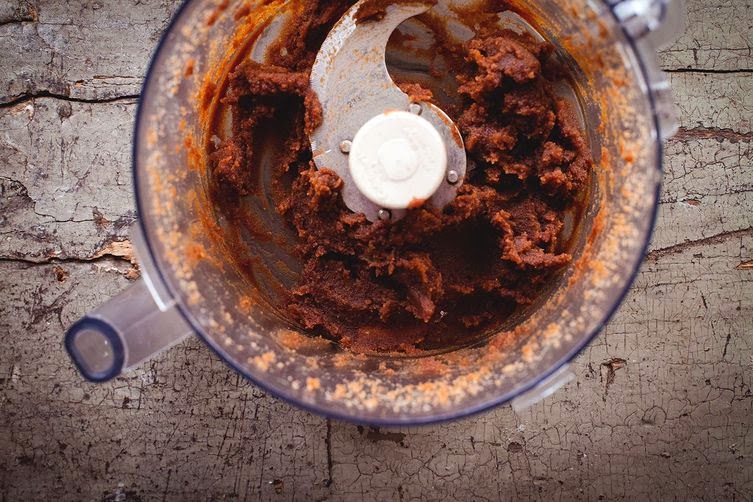
Blend hazelnuts in a food processor or blender until they form a thick, smooth paste. This should take approximately five minutes. It will be crumbly at first but the crumbs will begin to come together to form a butter.


Add the butter, sugar, cocoa powder, salt, and extracts. Continue to blend until smooth, approximately one to two minutes.


Melt together the chocolates and heavy cream in a double boiler, stirring until a smooth ganache forms. Remove from heat and let cool for five minutes.


Once ganache has cooled slightly, add it to the food processor or blender and blend until just combined (around 15 seconds).

Transfer to jars and store in the fridge for up to a week. (The Nutella will firm up slightly in the fridge, so let it sit out at room temperature for approximately 30 minutes to soften the consistency).

Thursday, April 11, 2013

Why GMO Labeling Won't Cost Consumers a Dime


By Zack Kaldveer and Ronnie Cummins
Organic Consumers Association, April 9, 2013

The biotech industry, led by Monsanto, will soon descend on the state of Washington to try their best to defeat I-522, a citizens’ ballot initiative to require mandatory labeling of foods that contain genetically engineered (GE) ingredients. Voters should prepare themselves for an onslaught of discredited talking points, nonsensical red herrings, and outright lies designed to convince voters that they shouldn’t have the right to know what’s in the food they eat.

Topping the biotech industry’s propaganda playlist will no doubt be this old familiar tune: that requiring retailers to verify non-GMO ingredients in order to label them will be burdensome and costly, and the additional cost will be passed on to consumers who are already struggling to feed their families.

Playing to consumers’ fears of higher food costs makes good strategic sense, especially in tough economic times. But the argument doesn’t hold water, say food manufacturers and retailers who already have systems in place for verifying non-GMO, as well as rBGH-free, trans fat-free, country of origin and fair trade. The system involves using chain-of-custody, legally binding affidavits, not expensive testing.

“We have used the affidavit system repeatedly, without undue burden or cost,” said Trudy Bialic, Director of Public Affairs for Seattle-based PCC Natural Markets. PCC, the largest consumer-owned natural food retail co-operative in the United States, uses the affidavit system to ensure their chocolate isn't made using child slave labor, their dairy products don't come from animals subjected to rBGH hormones, and that all seafood was harvested using sustainable sources and practices.

Trader Joe’s, a privately held chain of nearly 400 U.S. stores, confirmed that the company’s private label products, under the names Trader Joe’s, Jose’s and Ming’s, are GMO-free, though the company doesn’t label them as such. In an email, a company spokesperson said:

" When developing products containing ingredients likely to come from genetically modified sources, we have the supplier of the product in question perform the necessary research to provide documentation that the suspect ingredients are from non-GMO sources.

This documentation is in the form of affidavits, identity-preserved certification of seed stock, and third-party lab results from testing of the ingredients in question."

Trader Joe’s performs random audits of items with suspect ingredients, using an outside, third-party lab to perform the testing, the company said. Trader Joe’s system is not unlike that of the USDA, which requires sworn statements from food producers to certify organic foods. The agency requires test samples from approximately 5 percent of products, all of which must be GMO-free in order to be certified organic. For the other 95 percent, the agency relies solely on sworn statements.

Clif Bar & Co. also requires affidavits from ingredient suppliers demonstrating they can meet the company's stringent non-GMO requirements.

Monsanto would have you believe that verifying and labeling for non-GMO ingredients is a costly and burdensome affair, but the fact that Trader Joe’s, known for its discount prices, can provide GMO-free private label products, which reportedly account for over two-thirds of the company’s estimated annual $9 billion in sales, takes the wind out of the “burdensome” argument. That leaves the cost of adding another line of ink to a label. Trader Joe’s doesn’t yet label its private label products as GMO- free, but the company cites a lack of clear labeling guidelines from U.S. governmental agencies as the reason it doesn’t label, not cost.

Megan Westgate, Executive Director of the Non-GMO Project confirmed what retailers who use the affidavit system said: "An affidavit system like what's proposed in I-522 is a powerful way to have a significant impact on the food supply with minimal cost."

How does the affidavit system work?

Companies selling non-GMO foods provide a sworn statement (i.e. an affidavit) to the retailer that the ingredients used are sourced from crops that aren’t intentionally genetically engineered. The affidavit, unless deliberately dishonest, protects the manufacturer and the retailer from liability in the case of unintentional GMO contamination.

Retailers are responsible only for labeling a few raw commodities that may contain GE ingredients, such as sweet corn, papaya, or squash. In these cases, the retailer can either stick a simple label on the bin or ask their supplier for an affidavit stating that the crop is GMO free.

Under this system, no costly testing for GE ingredients is required. No burdensome government oversight is necessary. The system is inherently designed to protect small grocers and retailers, at no additional cost to the customer or taxpayer.

The beauty of the affidavit system is that it offers retailers and manufacturers a simple, easy way to comply with a regulatory model that provides consumers with the right to know what’s in their food without increasing grocery costs. Even for manufacturers who might otherwise seek to pass on the trivial expense of relabeling to consumers, empirical studies show that the fear of losing customers in the competitive food industry will be a deterrent to raising prices. Did food costs change when we labeled calorie content?

Is the system reliable? Retailers say yes. Why would manufacturers intentionally deceive retailers only to open themselves up to a lawsuit and public relations nightmare? And the system has a proven track record. PCC Natural Markets, Trader Joe’s and Clif Bar all use affidavits, as do other manufacturers who use them for country-of-origin and no-trans fat labeling. And nearly two-thirds of the nation’s largest dairy processors use sworn affidavits from producers in order to label rBGH-free. (rBGH, or recombinant bovine growth hormone, is a synthetic, genetically engineered hormone injected into dairy cows to increase milk production).

Contrary to claims made by companies like Monsanto, states do have a constitutional right to label food. In fact, the Food, Drug and Cosmetic Act explicitly allows states to add language to labels so long as the federal government doesn’t require language on the same subject – a right that has consistently held up in federal court.

A chain-of-custody, legally binding affidavit labeling system empowers consumers to make more informed choices about what we eat, without increasing the costs of groceries or burdening retailers and manufacturers. One simple label to identify foods that have been genetically engineered, often using the genes of foreign bacteria and viruses, would lead more consumers to seek out sustainable, organic, non-GMO alternatives. And that – not some phony line about increased food costs – is why Monsanto is fighting labeling.

Zack Kaldveer is assistant media director at the Organic Consumers Association.

Ronnie Cummins is founder and director of the Organic Consumers Association. Cummins is author of numerous articles and books, including "Genetically Engineered Food: A Self-Defense Guide for Consumers" (Second Revised Edition Marlowe & Company 2004). 

Monday, December 17, 2012

Revealed: What the Beef Industry Pumps Into Your Dinner

A common industry practice puts consumers at higher risks for eating food contaminated by deadly pathogens -- and that's just the tip of the iceberg. 

By Tara Lohan


If acclaimed authors Upton Sinclair (The Jungle), Jeremy Rifkin (Beyond Beef) and John Robbins (Diet for a New America) haven't given you enough reasons over the last century to be wary of the meat industry, then a year-long investigation by the Kansas City Star may do the trick.

Mike McGraw kicks off the KC Star's investigative series by introducing Margaret Lamkin, who has been forced to wear a colostomy bag for the rest of her life, after a medium-rare steak she ordered three years ago at Applebee's was contaminated with a pathogen. The resulting illness destroyed her colon.

Of course we already know about E. coli and other food-borne pathogens; people have gotten sick from everything from spinach to peanut butter. But the news here is that what sickened Lamkin wasn't just the meat, but a process the industry uses to tenderize it. McGraw explains :
The Kansas City Star investigated what the industry calls "bladed" or "needled" beef, and found the process exposes Americans to a higher risk of E. coli poisoning than cuts of meat that have not been tenderized.

... Although blading and injecting marinades into meat add value for the beef industry, that also can drive pathogens - including the E. coli O157:H7 that destroyed Lamkin's colon - deeper into the meat.
By using this process (which according to the story, 90 percent of processors will use, depending on the cut), people are at a greater risk of exposure to life-threatening illness. And consumers have no way of knowing whether their meat has undergone this process.

Ending up with a fecal-contaminated burger is bad, but it's just the beginning of what the investigation uncovered. Here are the other key findings, as McGraw writes:
  • Large beef plants, based on volume alone, contribute disproportionately to the incidence of meat-borne pathogens.
  • Big Beef and other processors are co-mingling ground beef from many different cattle, some from outside the United States, adding to the difficulty health officials have tracking contaminated products to their source. The industry also has resisted labeling some products, including mechanically tenderized meat, to warn consumers and restaurants to cook it thoroughly.
  • Big Beef is injecting millions of dollars of growth hormones and antibiotics into cattle, partly to fatten them quickly for market. Many experts believe that years of overuse and misuse of such drugs contributes to antibiotic-resistant pathogens in humans, meaning illnesses once treated with a regimen of antibiotics are much harder to control.
  • Big Beef is using its political pull, public relations campaigns and the supportive science it sponsors to influence federal dietary guidelines and recast steaks and burgers as "health foods" people should eat every day. It even persuaded the American Heart Association to certify beef as "heart healthy."
Read the full investigation, and think about how this scenario fits into the larger picture of what we deem acceptable as a food system. Just last month Consumer Reports shared frightening findings about pork.
And there is a ray of good news. Ocean Robbins wrote today:
People are taking an increasing interest in the way that the animals raised for food are treated. In fact, a poll conducted by Lake Research partners found that 94 percent of Americans agree that animals raised for food on farms deserve to be free from cruelty. Nine U.S. states have now joined the entire European Union in banning gestational crates for pigs, and Australia's two largest supermarket chains now sell only cage-free eggs in their house brands.
The demand is growing for food that is organic, sustainable, fair trade, GMO-free, humane, and healthy. In cities around the world, we're seeing more and more farmer's markets (a nearly three-fold increase in the last decade), and more young people getting back into farming. Grocery stores (even big national chains) are displaying local, natural and organic foods with pride. The movements for healthy food are growing fast, and starting to become a political force.

Investigations like the one done by the Kansas City Star are crucial for public education, as is support for the growing food movement that needs help in turning purchasing power at the market into political power that can affect decisions about food safety and industry practices.

"Big agribusiness would probably like us all to sit alone in the dark, munching on highly processed, genetically engineered, chemical-laden, pesticide-contaminated pseudo-foods," Robbins writes. "But the tide of history is turning, and regardless of how much they spend attempting to maintain their hold on our food systems, more and more people are saying NO to foods that lead to illness, and YES to foods that help us heal."

Thursday, October 18, 2012

Have a 'Greener' Halloween

Halloween is right around the corner and before you know it, you'll be getting handfuls of little four-foot monsters, ghosts, and ghouls knocking on your door. And that means a lot of candy with questionable ingredients and excessive waste.

This year, look for natural candy and when possible Fair Trade certified sweets. A great resource for this is Natural Candy Store, a family-run business located in California and THE online place to go to find vegan and organic candy. All of the items are clearly marked with symbols to identify what categories they fall into, including those made in the US. Additionally, every piece they sell contains NO artificial colors or dyes, NO artificial flavors, NO artificial sweeteners, NO preservatives, NO hydrogenated oils. Check them out, you still have a several days to place your order just in time for Halloween.


Tuesday, August 7, 2012

Do certification labels really matter?

 More good information from our friends at NewHope360:

As consumers grow weary over subpar food regulations at the federal level, manufacturers are increasingly seeking ways to help shoppers distinguish their products from the sea of conventional (and often irresponsibly produced) items. Certification labels—sometimes referred to as eco labels—are skyrocketing in popularity. Among the most ubiquitous? Certified Organic, Fair Trade, Non-GMO Project, and Gluten Free. But while certifications signal something to the consumer, do they actually have tangible benefits for the farmers who grow the raw materials?

Chances are you have also seen the Rainforest Alliance Certified logo—characterized by a little green frog—on packages of natural chocolates, coffee, tea, or fruit juices. But what exactly does the logo mean? And how does it differ from the wealth of other eco labels available?

After researching the stipulations involved with the Rainforest Alliance Certification, it was time to venture into the belly of the beast and see the positive changes, if any, gleaned from sustainable agricultural methods first hand.

Destination? Guatemala.
Crop? Coffee.
Certification requirements
Obtaining and maintaining Rainforest Alliance Certification is tough. Farms must adhere to stringent standards set by the Sustainable Agriculture Network; including ecosystem and water conservation, wildlife protection, safe working conditions, and waste management, among others. There are 100 different criteria in total, 14 of which are critical, and absolutely necessary. During certification evaluation, the farm must score at least 80 percent adherence to achieve certification. Independent auditors inspect the farm every year in order to ensure criteria are upheld.

About the Rainforest Alliance Certified label
If a manufacturer wants to display the “little green frog” on their package, the product must contain at least 30 percent Rainforest Alliance Certified content on the understanding that it takes time to build supply chains. But there are a few conditions: The percentage must be labeled on package to ensure transparency, and the company must commit to scale up by 15 percent each year until the product reaches 100 percent certified materials.

Making compost
La Azotea, a coffee farm located just outside the historic city of Antigua, Guatemala, lies in the shadow of three volcanoes, one of which emits smoke almost daily. The Rainforest Alliance Certified farm follows a rigorous composting system. Workers mix coffee pulp and horse manure into long rows, and let it sit and bake in the sun.

The composting process
"After 38 to 40 days, the compost is moved into a dark indoor shed for 8 days, where it’s processed by worms—creating a rich, dark soil," says Vicente Cuyuch, compost manager at La Azotea. "The compost is applied either at the roots or sprayed directly onto the coffee plant."
Along with producing a stronger and healthier plant, using compost enhances the end product too—many say La Azotea’s coffee is perfectly balanced.


Fostering biodiversity
In the Northwest region of Guatemala, nestled deep into the mountainous landscape rests ADESC (Asociación de desarrollo Social Los Chujes), a group of 68 small coffee farms certified by the Rainforest Alliance. 5,250 feet in elevation, the farm certainly looks like a rainforest. The coffee plants are small and shrub-like, and stand no more than eight feet tall (making it easier for workers to harvest by hand).
Most coffee in Guatemala is grown in the shade a portion of the year. Tall, feathery gravilea trees are planted to provide shade and humidity during the dry summer months. Other vegetation like mango and banana trees are planted to encourage bird populations and butterflies. When standing in the coffee grove you can hear wildlife in the area. The presence of spiders on the coffee plants is a hallmark of a healthy forest, says Mario Lopez, agriculture project coordinator for the Rainforest Alliance. ADESC sells all of it's coffee to Nespresso—a company that encourages sustainable coffee agriculture.

Water filtration
Cultivating larger trees amidst smaller coffee plants fosters a stronger root structure, which prevents erosion of the mountainside. Here, we see when soil contains more plants, it filters water better, leading to clearer rivers. This demonstrates the importance of having a complex plant system (multiple types of plants growing in one area rather than one species).

Dual fertilizers
Farms aren’t required to be organic in order to be Rainforest Alliance Certified. But they are prohibited from using most pesticides or planting GMOs (more on this later). Organic coffee in the Guatemalan highlands actually has lower yields and lower quality: the berries are smaller, and the acidity is unbalanced. One farmer said organic coffee must be grown in 100 percent shade all the time—which leads to more bugs.

Some conventional farmers are untrained in responsible agriculture: fertilizers are often overused because they assume the more chemicals, the better. At ADESC, soil samples are collected and analyzed every year to determine what type and how much fertilizer—a combination of nitrogen, phosphorus, and potassium—is needed. Organic fertilizer, made from the outer layer of the coffee beans (called parchment or pulp), is used to improve the quality of the soil. Farmers apply both types of fertilizer in a half-moon shape around the base of the coffee plant, and cover it with soil to prevent runoff into rivers.

Meet Latissia Monzón Gómez
Latissia Monzón Gómez has been working with the coffee association for twelve years. She owns a beautiful 8.6 acre parcel of land in ADESC that she calls The Garden. It’s a steep farm, and it contains step-like terraces built in order for farmers to access the plants. Prior to obtaining Rainforest Alliance Certification, Latissia saw climate change first hand: it used to rain a little bit every day, but now there are large storms, followed by long droughts—and she felt helpless against it.
“We don’t have to be a part of this program, but we do it voluntarily because we have to adapt to and mitigate climate change,” explains Gómez. “To mitigate means to reduce our impact—we are responsible for the environment. Although my farm is tiny, maybe it can inspire others to be more sustainable.”
Gómez frequently gives speeches to other coffee farms in the area to advocate for environmentally friendly agriculture.

Non-GMO
While there are no genetically engineered crops the Rainforest Alliance normally certifies, the organization takes a strong stance against GMOs—especially considering there have been transgenic experiments in coffee, albeit with no field deployment.
“Potential health impacts aside, there are significant ecological risks that we believe have not been sufficiently studied,” says Chris Wille, chief of sustainable agriculture fore the Rainforest Alliance. “These include possible impacts on pollinators and other wildlife, potential runaway hybridization, and the risk of GMOs turning invasive. The study results are all over the map.
“Anyways, with a large percentage of consumers and even entire countries (for example, Germany) avoiding GMOs like the plague, green-minded food companies and retailers don’t want GMOs, certified or not.”

Certification challenges
Apart from following the practices required, many farm owners think training their workers is the hardest aspect of sustainable agriculture.
“You have to get the workers to understand the impacts agriculture has on the environment,” says Oscar Ramos, farm manager at La Azotea. “If someone has been farming with agrochemicals for decades, it’s a lot to ask to have them change their methods. Once they understand sustainability, they start to care. And then they start to take pride in their work."

Photos courtesy of the Rainforest Alliance.