Showing posts with label GMO Free. Show all posts

Tuesday, November 4, 2014

10 Organic Thanksgiving Recipes

It’s the ultimate foodie day: Thanksgiving! But here’s something we’re not thankful for: Many traditional Thanksgiving staples, such as cranberries, green beans, sweet potatoes, and leafy greens, rank among the top foods at risk for toxic pesticide residue, according to The Organic Center's new Dietary Risk Index. Make this year’s Thanksgiving your healthiest yet with organic foods, free from pesticides, GMOs, hormones, and antibiotics.

“The only real way to protect your family from [the risk of toxic pesticide residue] is to purchase organic foods, particularly those fruits and vegetables that pose the greatest risk," says The Organic Center board member Sara Snow. “The Dietary Risk Index makes it easy by clearly listing which foods those are.”

Show your love by buying as many organic ingredients as you can and using them in these delectable recipes. “By preparing an organic Thanksgiving, you’ll be providing your family with nutritious food that’s both good for you and for the planet,” says Snow.

http://deliciousliving.com/recipes/roast-turkey-sage

Roast Turkey with Sage

A gorgeous centerpiece entree (see full turkey on previous frame). Look for organic and heritage turkeys, which are raised without hormones, antibiotics, or additives. View recipe.

http://deliciousliving.com/recipes/herbed-bread-and-vegetable-stuffing-0


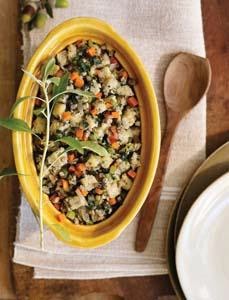
Herbed Bread and Vegetable Stuffing

This vegetable-studded stuffing adds flavor and nutrients to a typically bread-heavy dish. Use organic, sprouted bread for even more texture. View recipe.

http://deliciousliving.com/food/fresh-spinach-artichoke-baked-dip

Fresh Spinach-Artichoke Baked Dip

Enjoy this lightened version of the classic artichoke dip appetizer—and be sure to use organic spinach. View recipe.
http://deliciousliving.com/recipes/goat-cheese-tart-marinated-beets-and-arugula-0

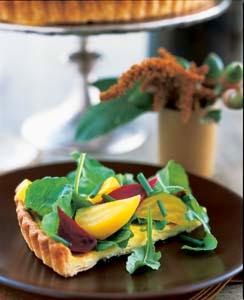
Goat Cheese Tart with Marinated Beets and Arugula

Conventionally grown beets are often genetically modified (GMO); avoid this by buying organic beets for this lovely, light appetizer or starter course. View recipe.

http://deliciousliving.com/recipes/parsnip-and-fennel-pur-e-0

Parsnip and Fennel Puree

It's not Thanksgiving without some version of mashed potatoes! This sophisticated version adds natural sweetness with organic parsnips and fennel. View recipe.

http://deliciousliving.com/recipes/kibbeh-apples-walnuts-and-feta-0

Kibbeh with Apples, Walnuts, and Feta

This vegetarian, Mediterranean-inspired entree will please everyone at the table; you can also make it one day ahead. To avoid rBGH, use organic yogurt for the delicious, dill-infused sauce. View recipe.

http://deliciousliving.com/recipes/cranberry-pomegranate-relish

Cranberry-Pomegranate Relish

Easy and tangy, this refreshing cranberry relish features organic orange peel for a bright finish. View recipe.

http://deliciousliving.com/recipes/apple-cranberry-lattice-pie

Apple-Cranberry Lattice Pie

Organic apples, an early symbol of the organic movement, combine beautifully with lemon and cranberries in this seasonal dessert. View recipe.

http://deliciousliving.com/recipes/fig-pie

Fig Pie

This novel, savory-sweet dessert features juicy, fresh figs; it's wonderful paired with fresh goat cheese. View recipe.

http://deliciousliving.com/recipes/cranberry-squash-pie-1

Cranberry Squash Pie

An Ayurvedic-inspired finale to your organic feast; the ingredients promote peacefulness because they're free of caffeine and strong spices. View recipe.

Tuesday, December 31, 2013

Maybe your 2014 New Year’s Resolution Should Be Eating Vegan Mayo


Why eat Vegenaise if you aren’t a vegan? Mayo can be enough of a culinary risk of its own (we try not to think about it too much). Well, apparently Vegenaise is AWESOME. So swears Slate writer Katherine Goldstein in the slightly hyperbolically titled “The Most Incredible Condiment You Probably Aren’t Using”:
The flavor was much lighter than regular mayo, and had a pleasing balance of flavors that made regular Hellmann’s taste both too sweet and too sour by comparison. Vegenaise’s texture is pleasantly smooth and airy, and much less goopy than store-bought mayo.
Did we mention that it’s made with solar power and is totally GMO-free? And it comes in fancy flavors like pesto, roasted garlic, and BBQ? OK, this is sounding pretty good …
As I tried it on a range of foods … slowly but surely, I realized its motto was right. Vegenaise, shockingly, tastes better than mayo. As an added bonus, it has less saturated fat and cholesterol than the regular stuff. And while many meat substitutes have ingredient lists that read like a science experiment, Vegenaise actually has no additives or preservatives.
Lest you discount Goldstein as a freak Vegenaise evangelist, she force-fed 15 coworkers the stuff, and 12 of them preferred it to regular mayo.

There’s only one way to find out if Vegenaise is actually better than mayonnaise, as its tagline claims: Try it. Hey, that’s a way better New Year’s resolution than going to the gym, right?
[via grist]

Tuesday, December 3, 2013

How to Find Great Organic Wine


It was the late 1990s when “organic wine” began appearing on store shelves. Many consumers, including this writer, were thrilled to finally discover organic wine options. But according to Adam Morganstern, wine expert and editor of the Organic Wine Journal, many wines that aren’t labeled organic actually are. “Some of the best organic wines in the world have always been organic; they just don’t put it on their label,” he says. A deeper look into the labeling of organic wine offers the full story.

So what is organic wine anyway? It depends on the country that it comes from, but for the most part organic wine is defined as being made from grapes grown without pesticides, fungicides and other chemicals. In the US, there are two categories for organic wine: wine made from organic grapes, and organic wine that is made from organic grapes and does not contain any added sulfites.

What is Organic Wine?

Most winemakers add very small amounts of sulfites (“We’re talking parts per million,” Morganstern says) to help preserve wine. There is a spirited debate among winemakers whether the addition of sulfites is necessary or not. Wine naturally contains small levels of sulfites, which are a byproduct of yeast fermentation. In the European Union, wine can have added sulfites and still be organic.

If you prefer wine that is made from organic grapes and doesn’t contain added sulfites, your best bet is to buy wine labeled “organic.” Many stores now have organic wine sections with at least five or so varieties of organic wine. Asking your local wine merchant for more organic varieties is also a good way to increase offerings, Morganstern advises.

If you are okay with wine made with grapes that are grown organically and has added sulfites, the world of organic wine options opens up significantly.

“A lot of the best wines in the world may be made with organic grapes, but those manufacturers never felt the need to say anything. They felt they were growing their grapes the best way and want to be known for making great wine; they don’t want to be known for making organic wine,” explains Morganstern. Sometimes it comes down to placement on the shelf. “Many wines labeled organic get placed in the organic wine sections at the back of the shop; a good Bordeaux maker wants his wine in the Bordeaux section, even if it’s organic.”

You also have a growing number of wine manufacturers that have switched to organic farming methods. “I can’t tell you how many winemakers I’ve spoken with who have taken a corner of their vineyard and grown it organically,” Morganstern says. “Then at harvest time they taste a conventional grape and it’s just kind of dull; and then they take a bite of an organic grape and it’s bursting with flavor and they say, ‘Well, there’s no question about what’s going to make better wine.’”

So, how can you spot the wines grown with organic grapes if they’re not always labeled? Get to know your local wine merchant. The more you show interest in what’s important to you, the more they will be able to help you and meet your needs, Morganstern recommends.

He also suggests using websites like Organic Wine Journal. Here you’ll find lists of organic wineries by country. These days many restaurants indicate organic wines on the menu and some have sommeliers on staff who can walk you through their wine list. “The important thing is to let the merchant know that you want organic. That indicates to them a demand for it and then they can work on getting you the best organic options,” Morganstern says.

Wednesday, October 30, 2013

Would GMO Labeling Jack Up Food Prices?


The push to require labels for genetically modified food, which flared up in California before drowning under a flood of industry cash last year, is now underway in Washington state. Predictably, agrichemical and organic interests are pouring money into, respectively, defeating and supporting a ballot initiative called I-522, which would require foods containing GMO ingredients to bear labels. Just as predictably, the agribusiness interests are garnering much more money to kill the effort than their organic peers are in supporting it—outspending them $17.1 million to $4.6 million, the Spokane-Review reported.

Meanwhile, in a development that broke late Wednesday, the Washington state attorney general has filed a complaint alleging that the Grocery Manufacturers Association, a trade group that donated $2 million to the effort to defeat California's labeling initiative, violated state campaign laws and "spent more than $7 million while shielding the identity of its contributors," according to its press release.

As in California, the effect on food prices is emerging as a point of contention. Opponents of labeling, pointing to a 2012 study prepared during the California fight by Northbridge Environmental Management Consultants, say that the new rules would cost consumers $350 to $400 annually per household. The Northbridge paper, though, was funded by the industry-dominated campaign to stop Prop 37, as the California initiative was known. Campaign records show that Northridge received a total of $97,371 in five payments during 2012.

Supporters of the Washington initiative, in turn, point to a rival 2012 study, this one prepared by Joanna M. Shepherd of Emory University School of Law, which found that "food prices [are] likely to remain unchanged for consumers." That study was commissioned by the Alliance for Natural Health, a group that advocates for "the right of natural-health practitioners to practice and the right of consumers to choose the healthcare options they prefer."

So which is right? Over at Grist, Michael Lipsky, a distinguished senior fellow at the progressive think tank Demos, argues that labeling wouldn't likely cost consumers much at all. The cost of changing labels would be trivial, he writes—food manufacturers "do it all the time." Ever seen the words "new and improved" on some boxed delicacy?

The Northbridge study, he shows, is based on the assumption that, in order to avoid having to declare that their products contain GMOs, food manufactures will rapidly switch over to non-GMO ingredients, which would cost more to procure. That's because upwards of 80 percent of US corn, soybeans, and sugar beets are genetically modified—and iterations of these three crops suffuse US processed foods, providing sweeteners (high-fructose corn syrup and beet sugar), fats (corn and soy oil), and a litany of ingredients like various thickeners. For food manufacturers to get non-GMO versions of these substances, they'd have to pay a premium in the marketplace—hence higher ingredient costs that they'd want to pass on to consumers.

But that effect wouldn't last long, Lipsky argues. "If labeling were required, particularly if (and when) the labeling requirement is adopted by other states, demand for non-GMO versions of corn, soybeans, and sugar beets—the basic GMO crops—would increase, production would expand, and prices for non-GMO ingredients would decline," he writes. That makes good sense: basic supply and demand.

And here's something Lipsky didn't get to: Even in the short term, the effect on retail prices would likely be small. That's because ingredients make up a tiny portion of the expenses incurred by manufactures to process food and move it to grocery store shelves. Transportation, marketing, processing—all of these things cost more than the actual food in the box of cereal or frozen dinner at Walmart.

How tiny are the costs of ingredients? Consider a box of corn flakes—which are presumably made largely of GMO corn (it's impossible to know for sure, because no US state requires labeling). In this 2008 report (currently available online because it has been republished on a non-government server) on the effect of ethanol on food prices, a US Department of Agriculture researcher crunched the numbers (pun fully intended) on the how much money companies spend on corn to make your cereal:
[A]n 18-ounce box of corn flakes contains about 12.9 ounces of milled field corn. When field corn is priced at $2.28 per bushel (the 20-year average), the actual value of corn represented in the box of corn flakes is about 3.3 cents.
And what happened after the corn ethanol program pushed corn prices up to $3.49 per bushel—a 49 percent jump? The total cost of corn in the cereal box rose to 4.9 cents. In other words, paying a 49 percent premium pushed up the corn cost in a box of corn flakes a grand total of 1.6 cents. An 18-ounce box of corn flakes contains 18 servings—meaning that much-pricier corn translated to an increase of less than 0.1 cents per bowl. For a family of four that consumes four bowls of flakes every day, that's about $1.46 extra for the year.

So even if manufacturers had to pay a hefty premium for non-GMO corn, the retail price of food would barely budge. Whatever you think about GMO labeling, the concern that it would significantly jack up food prices is probably specious.

Friday, July 12, 2013

Why to Support Labeling GM Foods

Many U.S. states have mandatory labeling of genetically modified foods on their legislative agendas. Survey after survey shows that more than 90 percent of us want GM foods to be labeled. Now is the time to contact your elected representatives and let them know you’re concerned about genetically modified food.


Genes form the building blocks of all life. Genetic modification — the technological shuffling of those building blocks among unrelated species — has been heralded since the 1990s as a potentially powerful agricultural tool. But pretty much all the genetically modified (GM) foods that have come to market so far have been crop varieties engineered to resist herbicides or produce insecticidal compounds (so farmers could, theoretically, apply fewer chemicals), and milk from dairy cows given a GM growth hormone that forces them to give more milk. Some countries have adopted these products, but others have banned them because the actual benefits of GM varieties remain unclear, especially as pests adapt to the traits upon which the technology relies.

Both benefits and downsides for consumers are controversial. In 1992, the U.S. Food and Drug Administration ruled, based on woefully limited data, that GM foods were “substantially equivalent” to their non-GM counterparts. That ruling has been under fire ever since, but the government has failed to require new safety testing. Meanwhile, thousands of foods containing GM corn and soy have been introduced into our food supply (see the chart at How to Avoid Genetically Modified Food to learn how to avoid GM foods).

Recent studies have escalated public concern and renewed demands that GM foods be labeled. Studies have linked genetically modified organisms (GMOs) to cancer, deterioration of liver and kidney function, stomach inflammation, and impaired embryonic development.

Whether you’re for or against GM foods, one thing’s for certain: The science is incomplete.

A GMO labeling initiative on the 2012 ballot in California failed by 53 to 47 percent. Proponents of labeling spent $7.3 million; Big Ag and food processors spent $44 million. Labeling GM foods is about much more than just food safety. It’s about our right as consumers to know what we are eating. But labeling is also about how dominant we are going to allow Big Ag to become. Some of us don’t want to eat GM foods or feed them to our livestock. Others push for labeling because we want to make sure our food policy isn’t set by a handful of multinational corporations.

In the United States, we expect food to carry a label that tells us what’s in it. We require that our orange juice reveal if it is made directly from oranges or “from concentrate.” We require labels to tell us if salt, sugar, MSG, artificial flavors or colors, vitamins, or other ingredients have been added. We require meat labels to reveal when it has been pumped with up to a 12 percent saltwater “flavor solution.” And we require milk to indicate whether it is skim, 1 percent fat, 2 percent fat or whole. GM foods should be labeled; there is simply no good argument against telling consumers the whole story.

Monsanto and big food companies like to claim that genetic engineering is essential to feed the world’s ever-growing population. That’s nonsense — most hunger is due to economic inequality and systemic corruption that prevents food from getting to where it’s needed, not due to food shortages. And on the note of the “world’s ever-growing population,” it’s time for society to recognize that unlimited population growth is not sustainable to begin with. We need to choose a wiser course.

Survey after survey shows that 90 percent or more of us want GM foods to be labeled. The GMO-labeling initiative in California almost passed last year, despite the oceans of money pouring in to defeat it. Nearly half of U.S. states now have mandatory GM labeling on their legislative agendas.

If you’re concerned about labeling GM foods, now is the time to contact your elected representatives.

Monday, June 17, 2013

Squirrels Prefer Organic Over GMO Corn


Paul Fonder had heard about experiments showing that when given the choice animals will prefer non-GMO over GMO corn.

After reading an article from the May 2008 issue of The Organic & Non-GMO Report, “Mice eat farmer’s non-GM corn, ignore GM,” Fonder decided to try an experiment himself.

“I was curious to see what kind of corn squirrels would favor,” said Fonder, an organic dairy farmer in Big Stone City, South Dakota.

Squirrel always ate organic

Last fall, Fonder conducted an experiment in his backyard. He built a squirrel feeder and put genetically modified corn fresh from a neighbor’s field on one post and one-year-old organic corn on the other.

The squirrels ate the organic corn first. “You would expect squirrels to prefer fresh corn over corn that’s a year old, but they totally preferred the organic corn,” Fonder said.

Fonder repeated the experiment five times, using different varieties of organic and GM corn. Each time the squirrels ate the organic corn. They would eventually eat the GMO corn but only after the organic corn was gone.

“The squirrel could have switched to GMO, but it didn’t,” he said. “It knew it was different.”

Fonder posted his findings on Twitter and Facebook, and his experiment went viral, receiving 20,000 Facebook likes.

A representative from Pioneer Hi-Bred seed company even contacted Fonder and suggested that a more accurate test would be to use the same varieties of non-GMO and GMO corn.

Transitioned to organic dairy production

Fonder, his brother, and four cousins transitioned to organic dairy production in 2003. “We got tired of riding the conventional milk roller coaster and using the chemicals,” he said.

Other farmers tried to discourage Fonder from going organic. “We told ourselves that if others can do it we can too,” he said. “All the things people try to scare you with about weeds and health (problems) of cows (with organic farming), it’s not true.”

Fonder and his family sell milk to Organic Valley. “Organic Valley has been good to us and is real good about educating farmers,” he says. “They are a wonderful co-op to work with.”

Fonder still finds his experiment hard to believe and hopes it contributes to greater awareness of GMO the risks. “It’s one thing to read about it; it’s another to see it. I just want to educate people. Monsanto has something to hide,” he says.

Thursday, April 11, 2013

Why GMO Labeling Won't Cost Consumers a Dime


By Zack Kaldveer and Ronnie Cummins
Organic Consumers Association, April 9, 2013

The biotech industry, led by Monsanto, will soon descend on the state of Washington to try their best to defeat I-522, a citizens’ ballot initiative to require mandatory labeling of foods that contain genetically engineered (GE) ingredients. Voters should prepare themselves for an onslaught of discredited talking points, nonsensical red herrings, and outright lies designed to convince voters that they shouldn’t have the right to know what’s in the food they eat.

Topping the biotech industry’s propaganda playlist will no doubt be this old familiar tune: that requiring retailers to verify non-GMO ingredients in order to label them will be burdensome and costly, and the additional cost will be passed on to consumers who are already struggling to feed their families.

Playing to consumers’ fears of higher food costs makes good strategic sense, especially in tough economic times. But the argument doesn’t hold water, say food manufacturers and retailers who already have systems in place for verifying non-GMO, as well as rBGH-free, trans fat-free, country of origin and fair trade. The system involves using chain-of-custody, legally binding affidavits, not expensive testing.

“We have used the affidavit system repeatedly, without undue burden or cost,” said Trudy Bialic, Director of Public Affairs for Seattle-based PCC Natural Markets. PCC, the largest consumer-owned natural food retail co-operative in the United States, uses the affidavit system to ensure their chocolate isn't made using child slave labor, their dairy products don't come from animals subjected to rBGH hormones, and that all seafood was harvested using sustainable sources and practices.

Trader Joe’s, a privately held chain of nearly 400 U.S. stores, confirmed that the company’s private label products, under the names Trader Joe’s, Jose’s and Ming’s, are GMO-free, though the company doesn’t label them as such. In an email, a company spokesperson said:

" When developing products containing ingredients likely to come from genetically modified sources, we have the supplier of the product in question perform the necessary research to provide documentation that the suspect ingredients are from non-GMO sources.

This documentation is in the form of affidavits, identity-preserved certification of seed stock, and third-party lab results from testing of the ingredients in question."

Trader Joe’s performs random audits of items with suspect ingredients, using an outside, third-party lab to perform the testing, the company said. Trader Joe’s system is not unlike that of the USDA, which requires sworn statements from food producers to certify organic foods. The agency requires test samples from approximately 5 percent of products, all of which must be GMO-free in order to be certified organic. For the other 95 percent, the agency relies solely on sworn statements.

Clif Bar & Co. also requires affidavits from ingredient suppliers demonstrating they can meet the company's stringent non-GMO requirements.

Monsanto would have you believe that verifying and labeling for non-GMO ingredients is a costly and burdensome affair, but the fact that Trader Joe’s, known for its discount prices, can provide GMO-free private label products, which reportedly account for over two-thirds of the company’s estimated annual $9 billion in sales, takes the wind out of the “burdensome” argument. That leaves the cost of adding another line of ink to a label. Trader Joe’s doesn’t yet label its private label products as GMO- free, but the company cites a lack of clear labeling guidelines from U.S. governmental agencies as the reason it doesn’t label, not cost.

Megan Westgate, Executive Director of the Non-GMO Project confirmed what retailers who use the affidavit system said: "An affidavit system like what's proposed in I-522 is a powerful way to have a significant impact on the food supply with minimal cost."

How does the affidavit system work?

Companies selling non-GMO foods provide a sworn statement (i.e. an affidavit) to the retailer that the ingredients used are sourced from crops that aren’t intentionally genetically engineered. The affidavit, unless deliberately dishonest, protects the manufacturer and the retailer from liability in the case of unintentional GMO contamination.

Retailers are responsible only for labeling a few raw commodities that may contain GE ingredients, such as sweet corn, papaya, or squash. In these cases, the retailer can either stick a simple label on the bin or ask their supplier for an affidavit stating that the crop is GMO free.

Under this system, no costly testing for GE ingredients is required. No burdensome government oversight is necessary. The system is inherently designed to protect small grocers and retailers, at no additional cost to the customer or taxpayer.

The beauty of the affidavit system is that it offers retailers and manufacturers a simple, easy way to comply with a regulatory model that provides consumers with the right to know what’s in their food without increasing grocery costs. Even for manufacturers who might otherwise seek to pass on the trivial expense of relabeling to consumers, empirical studies show that the fear of losing customers in the competitive food industry will be a deterrent to raising prices. Did food costs change when we labeled calorie content?

Is the system reliable? Retailers say yes. Why would manufacturers intentionally deceive retailers only to open themselves up to a lawsuit and public relations nightmare? And the system has a proven track record. PCC Natural Markets, Trader Joe’s and Clif Bar all use affidavits, as do other manufacturers who use them for country-of-origin and no-trans fat labeling. And nearly two-thirds of the nation’s largest dairy processors use sworn affidavits from producers in order to label rBGH-free. (rBGH, or recombinant bovine growth hormone, is a synthetic, genetically engineered hormone injected into dairy cows to increase milk production).

Contrary to claims made by companies like Monsanto, states do have a constitutional right to label food. In fact, the Food, Drug and Cosmetic Act explicitly allows states to add language to labels so long as the federal government doesn’t require language on the same subject – a right that has consistently held up in federal court.

A chain-of-custody, legally binding affidavit labeling system empowers consumers to make more informed choices about what we eat, without increasing the costs of groceries or burdening retailers and manufacturers. One simple label to identify foods that have been genetically engineered, often using the genes of foreign bacteria and viruses, would lead more consumers to seek out sustainable, organic, non-GMO alternatives. And that – not some phony line about increased food costs – is why Monsanto is fighting labeling.

Zack Kaldveer is assistant media director at the Organic Consumers Association.

Ronnie Cummins is founder and director of the Organic Consumers Association. Cummins is author of numerous articles and books, including "Genetically Engineered Food: A Self-Defense Guide for Consumers" (Second Revised Edition Marlowe & Company 2004).