Friday, April 12, 2013

The key to preventing moldy berries? Vinegar!


Raspberries in particular seem like they can mold before you even get them home from the market. There's nothing more tragic than paying $4 for a pint of local raspberries, only to look in the fridge the next day and find that fuzzy mold growing on their insides.

When you get your fresh berries home from your local market, be sure to wash them with vinegar. 

It really works. When you get your berries home, prepare a mixture of one part vinegar (white or apple cider probably work best) and ten parts water. Dump the berries into the mixture and swirl around. Drain, rinse if you want (though the mixture is so diluted you can't even taste the vinegar) and pop in the fridge.

The vinegar kills any mold spores and other bacteria that might be on the surface of the fruit! Raspberries will last a week or more, and even strawberries go almost two weeks without getting moldy and soft. So, go ahead and stock up on those pricey little gems, knowing they'll stay fresh as long as it takes you to eat them.

[via Food Lush]

Thursday, April 11, 2013

Why GMO Labeling Won't Cost Consumers a Dime


By Zack Kaldveer and Ronnie Cummins
Organic Consumers Association, April 9, 2013

The biotech industry, led by Monsanto, will soon descend on the state of Washington to try their best to defeat I-522, a citizens’ ballot initiative to require mandatory labeling of foods that contain genetically engineered (GE) ingredients. Voters should prepare themselves for an onslaught of discredited talking points, nonsensical red herrings, and outright lies designed to convince voters that they shouldn’t have the right to know what’s in the food they eat.

Topping the biotech industry’s propaganda playlist will no doubt be this old familiar tune: that requiring retailers to verify non-GMO ingredients in order to label them will be burdensome and costly, and the additional cost will be passed on to consumers who are already struggling to feed their families.

Playing to consumers’ fears of higher food costs makes good strategic sense, especially in tough economic times. But the argument doesn’t hold water, say food manufacturers and retailers who already have systems in place for verifying non-GMO, as well as rBGH-free, trans fat-free, country of origin and fair trade. The system involves using chain-of-custody, legally binding affidavits, not expensive testing.

“We have used the affidavit system repeatedly, without undue burden or cost,” said Trudy Bialic, Director of Public Affairs for Seattle-based PCC Natural Markets. PCC, the largest consumer-owned natural food retail co-operative in the United States, uses the affidavit system to ensure their chocolate isn't made using child slave labor, their dairy products don't come from animals subjected to rBGH hormones, and that all seafood was harvested using sustainable sources and practices.

Trader Joe’s, a privately held chain of nearly 400 U.S. stores, confirmed that the company’s private label products, under the names Trader Joe’s, Jose’s and Ming’s, are GMO-free, though the company doesn’t label them as such. In an email, a company spokesperson said:

" When developing products containing ingredients likely to come from genetically modified sources, we have the supplier of the product in question perform the necessary research to provide documentation that the suspect ingredients are from non-GMO sources.

This documentation is in the form of affidavits, identity-preserved certification of seed stock, and third-party lab results from testing of the ingredients in question."

Trader Joe’s performs random audits of items with suspect ingredients, using an outside, third-party lab to perform the testing, the company said. Trader Joe’s system is not unlike that of the USDA, which requires sworn statements from food producers to certify organic foods. The agency requires test samples from approximately 5 percent of products, all of which must be GMO-free in order to be certified organic. For the other 95 percent, the agency relies solely on sworn statements.

Clif Bar & Co. also requires affidavits from ingredient suppliers demonstrating they can meet the company's stringent non-GMO requirements.

Monsanto would have you believe that verifying and labeling for non-GMO ingredients is a costly and burdensome affair, but the fact that Trader Joe’s, known for its discount prices, can provide GMO-free private label products, which reportedly account for over two-thirds of the company’s estimated annual $9 billion in sales, takes the wind out of the “burdensome” argument. That leaves the cost of adding another line of ink to a label. Trader Joe’s doesn’t yet label its private label products as GMO- free, but the company cites a lack of clear labeling guidelines from U.S. governmental agencies as the reason it doesn’t label, not cost.

Megan Westgate, Executive Director of the Non-GMO Project confirmed what retailers who use the affidavit system said: "An affidavit system like what's proposed in I-522 is a powerful way to have a significant impact on the food supply with minimal cost."

How does the affidavit system work?

Companies selling non-GMO foods provide a sworn statement (i.e. an affidavit) to the retailer that the ingredients used are sourced from crops that aren’t intentionally genetically engineered. The affidavit, unless deliberately dishonest, protects the manufacturer and the retailer from liability in the case of unintentional GMO contamination.

Retailers are responsible only for labeling a few raw commodities that may contain GE ingredients, such as sweet corn, papaya, or squash. In these cases, the retailer can either stick a simple label on the bin or ask their supplier for an affidavit stating that the crop is GMO free.

Under this system, no costly testing for GE ingredients is required. No burdensome government oversight is necessary. The system is inherently designed to protect small grocers and retailers, at no additional cost to the customer or taxpayer.

The beauty of the affidavit system is that it offers retailers and manufacturers a simple, easy way to comply with a regulatory model that provides consumers with the right to know what’s in their food without increasing grocery costs. Even for manufacturers who might otherwise seek to pass on the trivial expense of relabeling to consumers, empirical studies show that the fear of losing customers in the competitive food industry will be a deterrent to raising prices. Did food costs change when we labeled calorie content?

Is the system reliable? Retailers say yes. Why would manufacturers intentionally deceive retailers only to open themselves up to a lawsuit and public relations nightmare? And the system has a proven track record. PCC Natural Markets, Trader Joe’s and Clif Bar all use affidavits, as do other manufacturers who use them for country-of-origin and no-trans fat labeling. And nearly two-thirds of the nation’s largest dairy processors use sworn affidavits from producers in order to label rBGH-free. (rBGH, or recombinant bovine growth hormone, is a synthetic, genetically engineered hormone injected into dairy cows to increase milk production).

Contrary to claims made by companies like Monsanto, states do have a constitutional right to label food. In fact, the Food, Drug and Cosmetic Act explicitly allows states to add language to labels so long as the federal government doesn’t require language on the same subject – a right that has consistently held up in federal court.

A chain-of-custody, legally binding affidavit labeling system empowers consumers to make more informed choices about what we eat, without increasing the costs of groceries or burdening retailers and manufacturers. One simple label to identify foods that have been genetically engineered, often using the genes of foreign bacteria and viruses, would lead more consumers to seek out sustainable, organic, non-GMO alternatives. And that – not some phony line about increased food costs – is why Monsanto is fighting labeling.

Zack Kaldveer is assistant media director at the Organic Consumers Association.

Ronnie Cummins is founder and director of the Organic Consumers Association. Cummins is author of numerous articles and books, including "Genetically Engineered Food: A Self-Defense Guide for Consumers" (Second Revised Edition Marlowe & Company 2004). 

Monday, April 8, 2013

8 in 10 parents buy organic

ORGANIC TRADE ASSOCIATION 


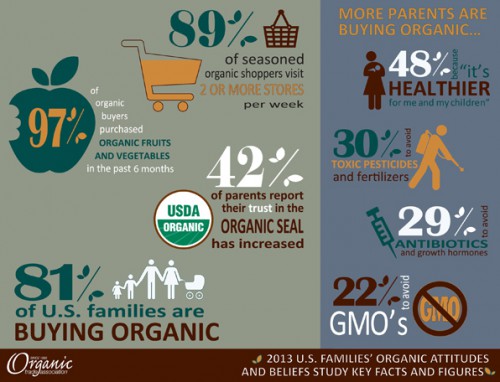
U.S. families are increasingly embracing organic products in a wide range of categories, with 81 percent now reporting they purchase organic at least sometimes. This finding is one of many contained in the Organic Trade Association’s (OTA’s) newly released 2013 U.S. Families’ Organic Attitudes and Beliefs Study, conducted Jan. 18 to 24, 2013.

 “More and more parents choose organic foods primarily because of their desire to provide healthful options for their children,” said Christine Bushway, OTA’s CEO and executive director.

Not only are more consumers choosing organic products at least sometimes, but the majority of those buying organic foods are purchasing more items than a year earlier. New entrants to buying organic now represent 41 percent of all families—demonstrating interest in the benefits of organic food and farming is on the rise.

Produce continues to be the leading category of organic purchases, with 97 percent of organic buyers saying they had purchased organic fruits or vegetables in the past six months. Breads and grains, dairy and packaged foods were also frequently cited (all scoring above 85 percent) among those who purchase organic. Families choosing organic foods are increasingly important to retailers of all types, with organic buyers reporting spending more per shopping trip, and shopping more frequently than those who never purchase organic food.

Consistent with findings from previous studies, nearly half (48 percent) of those who purchase organic foods said they do so because they are “healthier for me and my children.” Additionally, parents’ desire to avoid toxic and persistent pesticides and fertilizers (30 percent), antibiotics and growth hormones (29 percent), and genetically modified organisms (22 percent) ranked high among the reasons cited for buying organic products.

Awareness of the USDA Organic seal has also grown, with more consumers more likely to look for the seal when shopping for organic products. Moreover, over 4 in 10 parents (42 percent) say their trust in organic products has increased, versus 32 percent who indicated this point of view a year ago. In fact, younger, new-to-organic parents are significantly more likely to report improved levels of trust in organic products.

“Consumer trust is on the upswing for organic as the gold standard when seeking to avoid toxic and persistent pesticides, antibiotics, synthetic hormones, genetically engineered ingredients, and additives,” Bushway added.

Study findings, gathered in partnership with KIWI Magazine, are based on responses from 1,239 U.S. households about their attitudes and behaviors related to organic foods. The report provides in-depth information about organic consumers’ demographics, purchase motivation, labeling comprehension, shopping patterns, and more.

The 2013 U.S. Families’ Organic Attitudes and Beliefs Study is available for purchase.

Thursday, April 4, 2013

Growing Celery Indoors: Never Buy Celery Again


[via: 17 Apart]

Remember when we tested and shared how to grow onions indefinitely last week? Well, at the same time, we've been testing out another little indoor gardening project first gleaned from Pinterest that we're excited to share the success of today — regrowing celery from its base.

We've figured out how to literally re-grow organic celery from the base of the bunch we bought from the store a couple weeks ago. I swear, we must have been living under a rock all these years or just not be that resourceful when it comes to food, but we're having more fun learning all these new little tips and tricks as we dive deeper into trying to grow more of our own food.

This project is almost as simple as the onion growing project — simply chop the celery stalks from the base of the celery you bought from the store and use as you normally would. In our case, we had a particular homemade bean dip that needed sampling!


Instead of tossing the base, rinse it off and place it in a small saucer or bowl of warm water on or near a sunny windowsill — base side down and cut stalks facing upright.


We let our celery base hang out in the saucer of water for right around one week, give or take. Over the course of the week, the surrounding stalks began to dry out significantly, but the tiny little yellow leaves from the center of the base began thickening, growing up and out from the center, and turned a dark green. The growth was slow, but steady and evident.


After the 5-7 days were complete, we transferred our celery base to a planter and covered it completely save for the leaf tips with a mixture of dirt and potting soil.


We watered it generously and after planting in the soil, the overall growth really took off. Not only do we have celery leaves regenerating themselves from the base, but you can see clear stalks making their way up and out. It's truly fascinating what we have not even a week after planting in the soil:


A few notes:
  • Change out the water every couple of days while in the "saucer" phase of the project. We also used a spray bottle to spray water directly onto the base of the celery where the leaves were growing out. 
  • The tutorials we saw showed planting the celery directly into the dirt outside — you may want to go this route if you live in a temperate area or want to be able to harvest outdoors. We went with an indoor planter since it's still pretty cold here in VA, we have limited outdoor space in the city, and the space we do have is currently unprotected from our curious puppy.
  • Continue to generously water the celery after planting to keep it thriving. 
Be sure to follow 17 Apart for more updates!

Wednesday, April 3, 2013

Tea’s health benefits boost its popularity


Alex Treadway/National Geographic Image Collection via Alamy - India’s tea producers are benefiting from the growing popularity of the drink in the United States.


By Laura Ungar, Published: April 1, Washington Post


In the latte-obsessed United States, tea is gaining ground as scientists and the public learn more about its benefits.

A growing body of research suggests that the world’s second-most-consumed beverage — only water is more popular — helps prevent cardiovascular disease, burn calories and ward off some types of cancer.

“We don’t clearly understand why tea is so beneficial, but we know it is,” said Thomas G. Sherman, an associate professor in the Department of Pharmacology and Physiology at Georgetown University Medical Center. “There are lots of epidemiological studies, and so of course people see these studies and want to drink tea and gain these benefits.”

Nationally, tea purchases have risen for 20 consecutive years, annual supermarket sales have surpassed $2.2 billion, and away-from-home consumption of tea has grown by at least 10 percent each year for a decade, according to the Tea Association of the USA, a New York-based industry group. On any given day, the association says, 160 million Americans drink tea.

Although coffee is still king in the United States, change is brewing. Department of Agriculture statistics show tea drinking has increased as coffee drinking has declined: Per-person tea consumption was nine gallons in 2009, up from 7.3 gallons in 1980; per-person coffee consumption was 23.3 gallons in 2009, down from 26.7 gallons in 1980, about half what it was in the mid-1940s. And while studies also show that coffee is associated with many health benefits, including helping protect against diabetes and Parkinson’s disease, a typical cup has much more jitter-producing caffeine than tea does.

Manelle Martino, co-owner of Capital Teas in Washington, said she has seen the explosion of interest in tea firsthand. Her sales of loose-leaf tea have risen substantially each year since she opened the business in 2007. “We started the tea company with one shop. Now, there are six stores in the D.C. area,” she said. “People are becoming more health-conscious. You have baby boomers who are into preserving their youth. You see them wanting to take better care of themselves.”

Tea and cholesterol

Tea comes from the leaves of the warm-weather evergreen Camellia sinensis, and it is classified into five types: black, white, green, oolong and puerh.

Experts say all are healthful. Many scientists link health benefits to tea’s polyphenol antioxidants, which protect against oxidative stress, but others say they don’t know exactly which chemicals or combinations of chemicals in tea produce the benefits. Sherman, for example, said there’s no evidence connecting tea’s antioxidants to beneficial effects, and he pointed to a study showing that black tea reduces LDL, or “bad,” cholesterol without affecting antioxidant levels, suggesting something else in tea is causing this.

Numerous epidemiological studies — which establish correlation, not cause and effect — focus on tea’s role in reducing cardiovascular disease, the nation’s biggest killer.

A 2004 paper in the Archives of Internal Medicine, for instance, looked at hypertension rates among people who drank tea for at least a year. The study, conducted in Taiwan, found that those who drank about four ounces to 20 ounces of tea per day had a 46 percent lower risk of developing high blood pressure than people who didn’t drink tea regularly.


Another paper, published in 2002 in the American Journal of Clinical Nutrition, culled through the results of a large study concerning chronic disease and found that people drinking the greatest amount of tea — more than 12 ounces a day — had barely half the risk of heart attack as people who did not drink tea.

More recent cardiovascular research was presented in September at a symposium at the Department of Agriculture in Washington. One study found that black tea reduced blood pressure in all participants and counteracted the detrimental effects of high-fat meals in people with high blood pressure.


“The more tea you drink, the better,” Sherman said. “It’s astounding, really.”

Cancer prevention less clear

As for cancer prevention, the evidence is less compelling.

A review of studies published in the Journal of Cancer Research and Clinical Oncology last year suggested that consuming 10 Japanese-size cups of green tea a day helps prevent several cancers and protect against recurrence of colorectal cancer. And a 2006 review in the Journal of the American College of Nutrition of the beneficial effects of green tea noted studies linking tea to reduced risk of ovarian, prostate and breast cancers.

But that review also cited some conflicting research. For example, two studies revealed a breast cancer benefit, one showing a decreasing risk among Asian American women with rising tea intake and another showing a lower risk of recurrence among Japanese patients who drank three or more cups a day. But a larger Japanese study of more than 35,000 women concluded tea intake didn’t affect the risk of breast cancer.

And scientists at the Johns Hopkins Kimmel Cancer Center announced last week that black and green teas (and coffee) were among the foods and flavorings that affected a gene linked to cancer. But they said this doesn’t mean people should stop drinking tea and coffee, only that more research is needed.

Studies have also examined whether tea affects weight loss. One, from 2004, found that caffeine, theanine and perhaps other components in green tea powder suppressed weight gain and fat accumulation in laboratory mice.

There is also some evidence that drinking tea promotes digestive health generally. Gerry Mullin, an associate professor of medicine at Johns Hopkins School of Medicine and author of “The Inside Tract: Your Good Gut Guide to Great Digestive Health,” said tea appears to help control glucose and insulin and keep the gastrointestinal system running well.

“At the end of the day, these teas are anti-inflammatory in nature. They have anti-bacterial properties,” Mullin said. “They [boost] the immune system and provide a lot of different benefits.”
 
That soothing cup

Sherman’s wife, Guinevere Eden, loves to start her day with a soothing cup of tea. For the working mother of two preschoolers, the healthy brew conjures a quiet moment and a sense of well-being while stirring memories of her childhood in England.

“First thing in the morning, it feels so good,” said Eden, 45, of Potomac.

Over the course of a day, she said, she drinks five or six cups of tea. “That’s actually all I drink. I don’t drink coffee.”


Tea experts disagree on how much tea to recommend for better health. Some say two eight-ounce cups a day, while others say five or more cups.

Experts said tea’s relatively low caffeine levels make it possible to drink large amounts without the jitters, fast heartbeat and stomach upset that the same amount of coffee would probably induce. Black tea, which has more caffeine than green, oolong or white teas, has about half the caffeine of coffee.


Still, experts advise against overdoing it, noting that tea, unlike coffee, contains trace amounts of aluminum. But according to the National Cancer Institute, while aluminum can accumulate in the body and cause neurodegenerative disorders, there’s no evidence of aluminum toxicity associated with drinking tea.

Sherman said iced tea should provide the same benefits as hot tea, as long as it starts out as hot and is then cooled, not just brewed in the sun or made from store-bought powdered mixtures.

He said adding milk to tea may not be as beneficial as drinking it straight, since there’s some evidence that protein in milk binds to the healthful chemicals in tea and prevents them from being absorbed. Sugar doesn’t seem to reduce tea’s benefits, he and others said, although it comes with problems of its own, such as empty calories that can lead to weight gain.

Martino, of Capital Teas, said customers at her shops often ask about health benefits, especially after pronouncements by celebrity physicians such as Mehmet Oz. Whenever Oz mentions a certain tea, Martino said, “people come flooding in looking for that tea.”

Erika Sanchez, a manager at the Dupont Circle Teaism shop in Washington, said customers do much the same at her shop — and then discover how many different types of teas are out there: “If you’re new to the tea world, it can be surprising.”

America’s rising interest in tea has been attracting international attention.

Sundeep Mukherjee, principal adviser to the Darjeeling Tea Association, said three-quarters of the tea from that region of India is exported, with up to 10 percent going to the United States, a portion that’s been rising over the last decade as health benefits become more widely known.

“The tea industry is doing well,” Mukherjee said. “This is a product everyone drinks.”


Ungar is the medical writer at the Courier-Journal in Louisville.

Tuesday, April 2, 2013

Farmstand [App]: Discover and Share The Best of Your Local Farmers’ Market


Are you into eating locally grown food? Then you’ll enjoy Farmstand, an iPhone app built to grow and foster your local farmers and food.

Farmstand makes it easy to discover and share the best of your local farmers’ market. The iphone app lets you share photos, post deals; and by doing so, support local farmers. But they will soon take the experience beyond just the iphone as they are working hard on adding a web component featuring farmer profiles and restaurants that serve locally grown food.

Yay for locally grown food!  

Activity

Quickly find your closest market and see what’s happening at farmers’ markets around you.


Find a Market

Looking for fresh food in your area? Find a market wherever you are.


Market Information

Easy access to hours of operation, directions, and photos from other market goers.


Post Updates

See something awesome at the market? Share it with the Farmstand community and help promote your local market.


Learn more about their purpose or download the free iPhone app.


[via: SwissMiss]

Monday, April 1, 2013

National Farmworker Awareness Week highlights a dirty labor plight

This week it’s time to pay some respect to the folks who actually do most of that farming work.


The vast majority of our stateside fruits and vegetables are handpicked by more than 3 million migrant and seasonal farmworkers. Without those farmworkers, we’d be very hungry. But as a whole those workers are treated badly: They’re underpaid, underinsured, and undereducated. About half of them are undocumented, and only about a third are U.S. citizens. These workers bear the brunt of our food system with their bodies, but only California requires that they get water and bathroom breaks. On average, one farmworker dies on the job every day in the U.S., and laborers can be as young as 12 — legally.


[via: Grist]