Showing posts with label food preservation. Show all posts

Wednesday, July 27, 2016

Food Freezing Tips: How Long Can You Store Meals in Your Freezer? [Infographic]

Food preservation in cold temperatures has been practiced since the early days of mankind, although not as effortlessly as today when we have powerful freezers, polythene bags and plastic containers, freezer labels and other utensils that help us better preserve food. We also have the knowledge of how to do it properly.

To make sure defrosted food is as fresh, nutritious and tasty as before freezing it, there are certain rules to follow. For example:
  • Food should always be frozen at the peak of its ripeness/freshness;
  • Some types of food do not freeze well, such as eggs in shell or potatoes;
  • Liquids expand in cold temps, so it’s important to leave enough room in the container when freezing beverages, etc.
Most importantly, we must know how long we can keep each type of food in the freezer before it loses its taste or even becomes unsafe to eat (if air gets in).

The following infographic is created as a guide to help you figure out how long you can keep meat, seafood, ice cream and other food products in the freezer. Keep it on your fridge or freezer for quick reference when planning meals.


Monday, November 18, 2013

Tips to Freeze What You Grow

With plenty of gardening comes plenty of produce, but what can you do with all of it? You certainly can’t eat it all at once, and canning everything is a pain in the neck. However, your freezer might give you another option. Saving produce by freezing it is often very efficient, fast and easy to do. Most vegetables and fruits can be frozen without any loss of flavor. Plus by preparing it ahead of time you can make your meals faster and easier than ever. Here are some tips for freezing your produce:

Cut it Up

The first step to freezing your produce is preparation. You should cut the fruits and vegetables into the sizes you will use for meals. For example I peel and slice my peaches for use in pies and smoothies before I freeze them. I also shell my peas, dice my bell peppers, and shred my zucchini. By having the produce all ready to go it not only makes my meal preparation faster but makes it easier to freeze them. Keep in mind that some produce needs to be blanched before freezing to preserve the flavor and color.


Lay It Out

After the produce is prepared, it is time to freeze it. Although you can toss it all in a freezer bag and throw it in the freezer it is a lot harder to use it that way. It also takes up more room in your freezer. Instead, take a cue from the professionals and lay out your produce before freezing it. Get a large cookie sheet and line it. Then spread out the prepared produce in a single layer and freeze it. After it is frozen you can easily pour it into a container and it will be much easier to manipulate and defrost later. For liquids, like pureed produce and herbs, you have two options. You can pour it into an ice cube tray and freeze before putting the cubes in a bag. Or you can lay the bag on its side and freeze in a thin layer that is very easy to store.

Package It Well

Keep in mind that your produce will only stay fresh if you package it well. A regular sandwich bag will not do the trick. Instead make sure you use bags especially made for freezing or other methods that will keep your produce fresh. Vacuum sealing is a great way to keep produce fresh in the freezer for over a year!

Invest in a Good Freezer

Last but not least, you should invest in a good freezer to keep your produce lasting longer. The one that comes with your refrigerator is okay for short term storage, like a month or two, but for longer periods an independent freezer is much better at preserving foods. Just think about how much money you are saving on produce year round and it will make the investment of a freezer seem less overwhelming.

As you can see, freezing your produce is a great, easy way to make the most of your garden. Do not throw away rotten produce because you can’t eat it fast enough. Instead save it for up to a year or more in your freezer and have great fruits and vegetables any time of year that are tasty and homegrown.


Friday, April 12, 2013

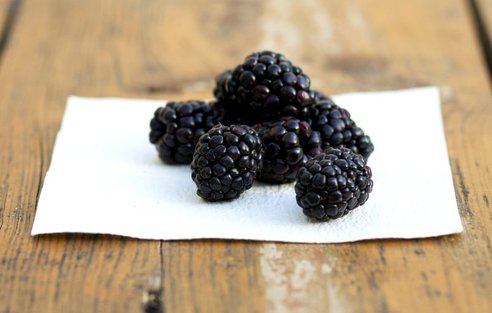
The key to preventing moldy berries? Vinegar!


Raspberries in particular seem like they can mold before you even get them home from the market. There's nothing more tragic than paying $4 for a pint of local raspberries, only to look in the fridge the next day and find that fuzzy mold growing on their insides.

When you get your fresh berries home from your local market, be sure to wash them with vinegar. 

It really works. When you get your berries home, prepare a mixture of one part vinegar (white or apple cider probably work best) and ten parts water. Dump the berries into the mixture and swirl around. Drain, rinse if you want (though the mixture is so diluted you can't even taste the vinegar) and pop in the fridge.

The vinegar kills any mold spores and other bacteria that might be on the surface of the fruit! Raspberries will last a week or more, and even strawberries go almost two weeks without getting moldy and soft. So, go ahead and stock up on those pricey little gems, knowing they'll stay fresh as long as it takes you to eat them.

[via Food Lush]

Wednesday, December 12, 2012

A Magical Paper Extends The Shelf Life of Produce, Organically

12-5
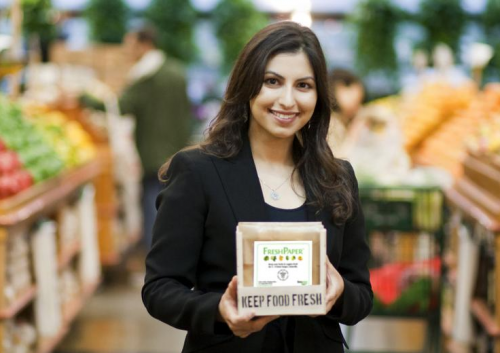
Have you ever come home from the market with armfuls of fresh fruits and vegetables only to find them wilting and rotting in the fridge a mere week later? Or even get home from your local produce market with a box full and anxiously scarf down pounds of fruit before it goes bad? So, the question presents itself: How do we keep produce fresh from farm to fork for an extended amount of time, and thus reduce food waste? The solution came from Kavita Shukla who didn't necessarily set out to solve the issue; her innovation developed from her middle school science project.

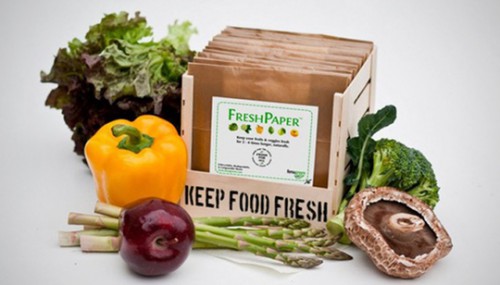
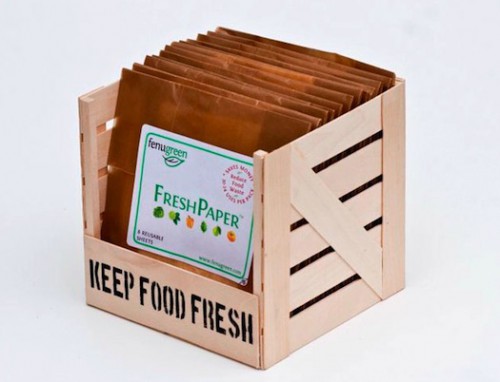
After years of research and development Fenugreeen FreshPaper was founded in 2010. The small magic squares of spice-infused paper were  developed as a remarkably effective way to keep food fresh - extending the shelf life of produce up to four times longer than usual.

The exact combination of herbs and spices used in FreshPaper is proprietary, of course, however the only ingredient Shukla will reveal is fenugreek, a spice often used in Indian cooking, which also lent its name to her company. screen-shot-2012-12-12-at-122632-pm
How it works:
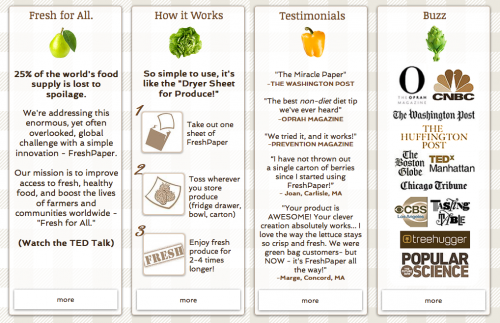
"It basically works by inhibiting bacterial and fungal growth, as well as the enzymes that cause fruit to over-ripen," Shukla explains. "The concept is that you can just drop a sheet into a drawer or carton. Sometimes people put it into a fruit bowl. Our customers call it a ‘dryer sheet for produce.'" Each certified organic and biodegradable sheet lasts about two to three weeks, until its distinctive maple-like scent begins to fade. "That's how you know it's no longer active," Shukla explains.
screen-shot-2012-12-12-at-122153-pm ​
Today, FreshPaper is used by farmers and families across the world and most recently has been made available in Whole Foods Markets. The growing distribution has allowed her to pursue her efforts to begin a "get one, give one" program benefiting local food banks, starting with those affected by Hurricane Sandy in New York and New Jersey. Shukla says the brand has grown entirely by word of mouth, and credits much of this grassroots energy to increased environmental awareness in consumers.
"As we start to learn more about what's going on with food waste, we realize that there's water involved, there's energy costs, land, resources, that go into creating the food that we eat," she says. "And with the economy, people are becoming much more conscious of being wasteful at home, because they know not only are they struggling, but there are people in the U.S. that have no access to fresh food at all. It seems that everyone is coming to understand the importance of buying less or conserving what we have, and how that fits into the larger food crisis."
Fenugreen is a social enterprise with the mission of "Fresh for All." 12-4 12-2 12-1 12-3
[sources: FreshPaper,  Fast Co.]

Tuesday, December 4, 2012

saving food from the refrigerator

4o-0

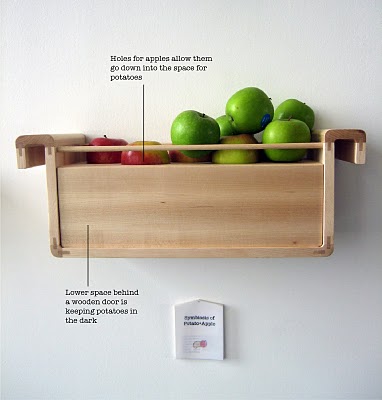
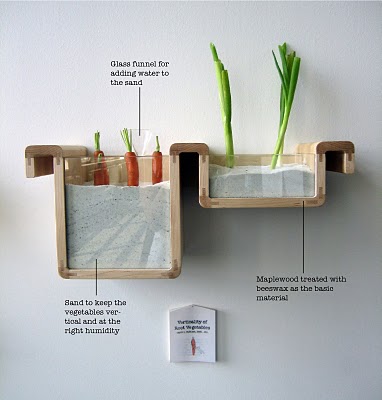
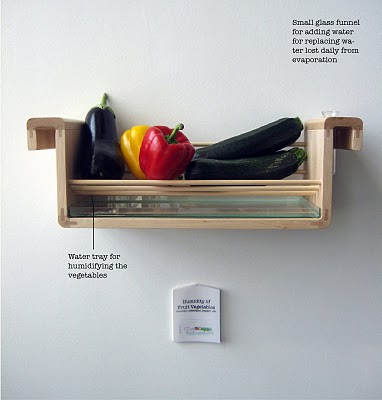
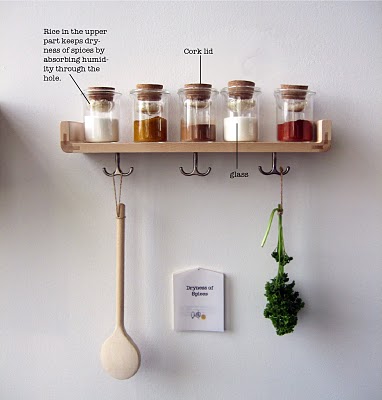
Although we think and talk about food on a constant basis, do we really know how best to preserve it or do we become lazy and leave the responsibility to technology? Design Academy Eindhoven graduate Jihyun Ryou thinks we no longer understand how to treat food. Her Save Food from the Fridge project involves placing certain foods on a group of "knowledge shelves" outside the fridge. With the goal of a better relationship with our food we may be able to waste less and conserve more energy, without sacrificing design aesthetics.
"Observing the food and therefore changing the notion of food preservation, we could find the answer to current situations such as the overuse of energy and food wastage. My design is a tool to implement that knowledge in a tangible way and slowly it changes the bigger picture of society. I believe that once people are given a tool that triggers their minds and requires a mental effort to use it, new traditions and new rituals can be introduced into our culture." - Jihyun Ryou
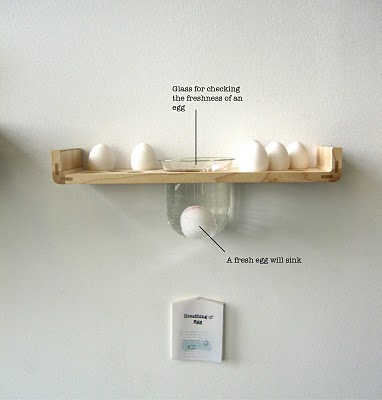
Her beautifully designed storage shelves aim to "re-introduce and re-evaluate traditional oral knowledge of food, which is closer to nature. Furthermore, it aims to bring back the connection between different levels of living beings, we as human beings and food ingredients as other living beings." For instance, the egg holder shelf includes a drop down cup of water to test the eggs. A ripe egg will always sink in water, so before breaking it open you can check to see its freshness. There is also a set of spice jars equipped with lids that hang down small bags of rice inside the jar. The rice is said to absorb humidity and keep the spices dry. There is even a hybrid apple/potato holder which keeps potatoes in a dark cabinet. Particularly focusing on the food preservation, it looks at a feasible way of bringing that knowledge into everyday life.

4o-5
4o-1
4o-2
4o-3
4o-4