Clean eating means choosing fruits, vegetables, and meats that are raised, grown, and sold with minimal processing.
Often they're organic, and rarely (if ever) should they contain additives. But in some cases, the methods of today's food producers are neither clean nor sustainable. The result is damage to our health, the environment, or both. So we decided to take a fresh look at food through the eyes of the people who spend their lives uncovering what's safe—or not—to eat. We asked them a simple question: "What foods do you avoid?" Their answers don't necessarily make up a "banned foods" list. But reaching for the suggested alternatives might bring you better health—and peace of mind.
1. Canned Tomatoes
Fredrick Vom Saal, PhD, an endocrinologist at the University of Missouri who studies bisphenol-A, gives us the scoop:
The problem: The resin linings of tin cans contain bisphenol-A, a synthetic estrogen that has been linked to ailments ranging from reproductive problems to heart disease, diabetes, and obesity. Unfortunately, acidity (a prominent characteristic of tomatoes) causes BPA to leach into your food. Studies show that the BPA in most people's body exceeds the amount that suppresses sperm production or causes chromosomal damage to the eggs of animals. "You can get 50 mcg of BPA per liter out of a tomato can, and that's a level that is going to impact people, particularly the young," says vom Saal. "I won't go near canned tomatoes."
The solution: Choose tomatoes in glass bottles (which do not need resin linings), such as the brands Bionaturae and Coluccio. You can also get several types in Tetra Pak boxes, like Trader Joe's and Pomi.
Budget tip: If your recipe allows, substitute bottled pasta sauce for canned tomatoes. Look for pasta sauces with low sodium and few added ingredients, or you may have to adjust the recipe.
2. Corn-Fed Beef
Joel Salatin, co-owner of Polyface Farms and author of half a dozen books on sustainable farming, gives us the scoop:
The problem: Cattle evolved to eat grass, not grains. But farmers today feed their animals corn and soybeans, which fatten up the animals faster for slaughter. But more money for cattle farmers (and lower prices at the grocery store) means a lot less nutrition for us. A recent comprehensive study conducted by the USDA and researchers from Clemson University found that compared with corn-fed beef, grass-fed beef is higher in beta-carotene, vitamin E, omega-3s, conjugated linoleic acid (CLA), calcium, magnesium, and potassium; lower in inflammatory omega-6s; and lower in saturated fats that have been linked to heart disease. "We need to respect the fact that cows are herbivores, and that does not mean feeding them corn and chicken manure," says Salatin.
The solution: Buy grass-fed beef, which can be found at specialty grocers, farmers' markets, and nationally at Whole Foods. It's usually labeled because it demands a premium, but if you don't see it, ask your butcher.
Budget tip: Cuts on the bone are cheaper because processors charge extra for deboning. You can also buy direct from a local farmer, which can be as cheap as $5 per pound. To find a farmer near you, search
allorganiclinks.com.
3. Microwave Popcorn
Olga Naidenko, PhD, a senior scientist for the Environmental Working Group, gives us the scoop:
The problem: Chemicals, including perfluorooctanoic acid (PFOA), in the lining of the bag, are part of a class of compounds that may be linked to infertility in humans, according to a recent study from UCLA. In animal testing, the chemicals cause liver, testicular, and pancreatic cancer. Studies show that microwaving causes the chemicals to vaporize—and migrate into your popcorn. "They stay in your body for years and accumulate there," says Naidenko, which is why researchers worry that levels in humans could approach the amounts causing cancers in laboratory animals. DuPont and other manufacturers have promised to phase out PFOA by 2015 under a voluntary EPA plan, but millions of bags of popcorn will be sold between now and then.
The solution: Pop natural kernels the old-fashioned way: in a skillet. For flavorings, you can add real butter or dried seasonings, such as dillweed, vegetable flakes, or soup mix.
Budget tip: Popping your own popcorn is dirt cheap.
4. Non-Organic Potatoes
Jeffrey Moyer, chair of the National Organic Standards Board, gives us the scoop:
The problem: Root vegetables absorb herbicides, pesticides, and fungicides that wind up in soil. In the case of potatoes—the nation's most popular vegetable—they're treated with fungicides during the growing season, then sprayed with herbicides to kill off the fibrous vines before harvesting. After they're dug up, the potatoes are treated yet again to prevent them from sprouting. " Try this experiment: Buy a conventional potato in a store, and try to get it to sprout. It won't," says Moyer, who is also farm director of the Rodale Institute (also owned by Rodale Inc., the publisher of Prevention). "I've talked with potato growers who say point-blank they would never eat the potatoes they sell. They have separate plots where they grow potatoes for themselves without all the chemicals."
The solution: Buy organic potatoes. Washing isn't good enough if you're trying to remove chemicals that have been absorbed into the flesh.
Budget tip: Organic potatoes are only $1 to $2 a pound, slightly more expensive than conventional spuds.
5. Farmed Salmon
David Carpenter, MD, director of the Institute for Health and the Environment at the University at Albany and publisher of a major study in the journal Science on contamination in fish, gives us the scoop:
The problem: Nature didn't intend for salmon to be crammed into pens and fed soy, poultry litter, and hydrolyzed chicken feathers. As a result, farmed salmon is lower in vitamin D and higher in contaminants, including carcinogens, PCBs, brominated flame retardants, and pesticides such as dioxin and DDT. According to Carpenter, the most contaminated fish come from Northern Europe, which can be found on American menus. "You could eat one of these salmon dinners every 5 months without increasing your risk of cancer," says Carpenter, whose 2004 fish contamination study got broad media attention. "It's that bad." Preliminary science has also linked DDT to diabetes and obesity, but some nutritionists believe the benefits of omega-3s outweigh the risks. There is also concern about the high level of antibiotics and pesticides used to treat these fish. When you eat farmed salmon, you get dosed with the same drugs and chemicals.
The solution: Switch to wild-caught Alaska salmon. If the package says fresh Atlantic, it's farmed. There are no commercial fisheries left for wild Atlantic salmon.
Budget tip: Canned salmon, almost exclusively from wild catch, can be found for as little as $3 a can.
6. Milk Produced with Artificial Hormones
Rick North, project director of the Campaign for Safe Food at the Oregon Physicians for Social Responsibility and former CEO of the Oregon division of the American Cancer Society, gives us the scoop:
The problem: Milk producers treat their dairy cattle with recombinant bovine growth hormone (rBGH or rBST, as it is also known) to boost milk production. But rBGH also increases udder infections and even pus in the milk. It also leads to higher levels of a hormone called insulin-like growth factor in milk. In people, high levels of IGF-1 may contribute to breast, prostate, and colon cancers. "When the government approved rBGH, it was thought that IGF-1 from milk would be broken down in the human digestive tract," says North. As it turns out, the casein in milk protects most of it, according to several independent studies. "There's not 100% proof that this is increasing cancer in humans," admits North. "However, it's banned in most industrialized countries."
The solution: Check labels for rBGH-free, rBST-free, produced without artificial hormones, or organic milk. These phrases indicate rBGH-free products.
Budget tip: Try your grocer's private label, but make sure it does not use rBGH.
7. Conventional Apples
Mark Kastel, former executive for agribusiness and codirector of the Cornucopia Institute, a farm-policy research group that supports organic foods, gives us the scoop:
The problem: If fall fruits held a "most doused in pesticides contest," apples would win. Why? They are individually grafted (descended from a single tree) so that each variety maintains its distinctive flavor. As such, apples don't develop resistance to pests and are sprayed frequently. The industry maintains that these residues are not harmful. But Kastel counters that it's just common sense to minimize exposure by avoiding the most doused produce, like apples. "Farm workers have higher rates of many cancers," he says. And increasing numbers of studies are starting to link a higher body burden of pesticides (from all sources) with Parkinson's disease.
The solution: Buy organic apples.
Budget tip: If you can't afford organic, be sure to wash and peel them. But Kastel personally refuses to compromise. "I would rather see the trade-off being that I don't buy that expensive electronic gadget," he says. "Just a few of these decisions will accommodate an organic diet for a family."
[via Prevention]


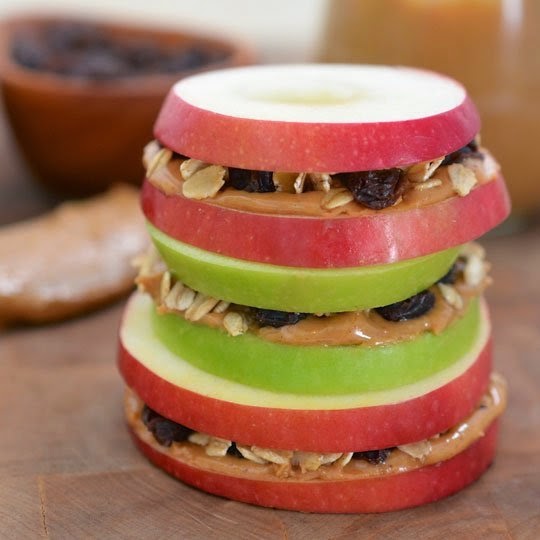 Apple Sandwiches with Honeyed Peanut Butter, Oats & Raisins


