Showing posts with label clean energy. Show all posts

Monday, August 27, 2012

HOW TO: Enjoy Your Labor Day Weekend

You probably don't need anyone to tell you how to spend your Labor Day weekend, but the fine folks at Organic Gardening came up with a list of a few nifty ways to enjoy the long weekend. We think they're pretty great, so we figured we'd share them with you. Enjoy!

1. Go to a farmers’ market. Harvest time is heading into high gear, so there’s no better time to head to a nearby farmers’ market and stock up on fresh, tasty edibles. You’ll not only get great field-fresh food; you’ll also support your local economy—and help fight global warming, since locally produced food comes without the carbon emissions required to truck it across the continent. Look for food grown with organic methods, and you avoid ingesting harmful chemicals and also support agriculture that adds carbon to the soil instead of releasing it into the atmosphere as a greenhouse gas. Now’s also a good time to sign up for a Community-Supported Agriculture (CSA) program, so you can get farm-fresh food every week.


2. Dig a root cellar. Not sure where or how to store all the fresh produce you got at the farmers’ market? A root cellar could be the answer. Don’t worry—you don’t have to literally dig one out of the ground (though you could, if you’re looking for a weekend project). Odds are there’s a cool, dark space somewhere in your home that will do: a shelf in the basement, an unused closet, even space under your porch.

3. Avoid overeating. Most holidays have a strong food component, and with its various buffets, cookouts, and picnics, Labor Day weekend is no exception. So follow the healthy-eating advice we offered back on July 4. Simple tactics like choosing smaller plates and keeping a count of your drinks can have a big impact on your calorie intake. And when it comes to overeating, keep the big picture in mind: Most of the food we’re exposed to has been pumped up with extra fat, sugar, and salt to play on our biologically hard-wired food cravings.


4. Get ready for fall allergies. If you’e prone to autumn allergies, ragweed and other triggers may already have you sneezing. Arm yourself with some easy nondrug allergy remedies that will cut down on the need for pills. Make sure your diet includes foods rich in folate, a B vitamin that seems to protect against allergies. And learn about some things you can do around the house to prepare for fall allergy season.


5. Do some late-season gardening. It’s not too late in the year to get your hands dirty, even if you don’t live in a southern part of the country. Good late-summer garden projects include planting garlic, installing a birdbath, or digging next year’s beds. You can also start a compost pile to build up some natural fertilizer for next year’s garden. If your garden’s lush right now, take an inventory of how high everything’s grown, and build some homemade supports and trellises that will give next year’s crop a lift. Or start your fall garden cleanup so your soil will he healthy and ready come spring.


6. Clean with vinegar. If you’re using some of the extended weekend to get some housecleaning done, try out the cheap, easy, ecosafe alternative to harsh chemical cleansers. Fast becoming the second-favorite liquid of the Rodale.com staff (water is number 1, of course), vinegar has all kinds of awesome uses. For basic cleaning, 1 part vinegar to 9 parts water will wipe out germs and grime. Mix vinegar with other natural ingredients to make specialized cleaners that cost a fraction of the toxic stuff you get at the stores.


7. Try canning or pickling. With some basic supplies and traditional canning techniques, you can preserve your favorite summer fruits and vegetables to enjoy in fall and winter. Check out Rodale.com's Nickel Pincher for a canning primer that you can use to make fruit preserves and jellies. You can apply the same skills to other fruit canning recipes, and try canning some tomatoes and pasta sauces. Or try your hand at pickling.


8. Relax. Maybe you’re one of those people who have trouble unwinding after a busy week. A great way to signal to your body that it’s time to relax is to spend some time in nature, so hang out outside as much as you can. Try a calming beverage and review our list of holiday stress-busters, which, though December-oriented, could also apply to anyone who’s running around buying charcoal or struggling with the logistics of one last desperate beach weekend. Anyway, those end-of-the year holidays will be here before you know it.

Friday, August 17, 2012

Harvard Student Designs Dirt-Powered Phone Charger

Wind turbines and solar panels don’t only generate large amounts of power, they do so without the pollution and danger that come along with fossil fuels. But for the millions around the world that live without access to reliable power, waiting for a wind farm to pop up is a long and frustrating task.
What many in developing nations need isn’t the ability to keep the lights on 24/7. For most, just having enough power to recharge a cell phone would be life-changing. That’s why Harvard Ph.D student Aviva Presser Aiden decided to look for a much smaller solution. One that’s as simple as a pile of dirt, actually.
A few years ago, the former engineer was working in Africa, looking to get more electric light into remote parts of the continent. While others focused on harnessing solar power, Aiden and her colleagues were more interested in the dirt beneath their feet. Previous research has revealed that soil microbes can be a natural source of energy. Certain naturally occurring soil microbes produce free electrons during the course of their ordinary metabolic processes. A Microbial Fuel Cell (MFC) uses a conductive surface to harvest these electrons and use them as a power source.
In 2011, Aiden’s idea for an MFC-based cell phone charger caught the attention of the Bill & Melinda Gates Foundation. The Foundation gave Aiden and her Harvard team $100,000 to turn the concept into a reality.
If you’re wondering how in the heck you convince soil-dwelling microbes to charge your phone, this explanation from PS Mag will help: “First you need some kind of jar, with a piece of graphite or some other non-corrosive metal, at the bottom. Then put in dirt with very little oxygen, and another piece of graphite. Soil microbes are constantly making electrons, but if there’s oxygen about they’ll put the electrons into the oxygen. If there isn’t any oxygen, they’ll dump the electrons on pieces of metal—i.e. the graphite.”
Unlike solar panels, MFCs do not require any sophisticated materials: they can be easily assembled in only a few minutes. If Aiden’s concept is successful, Africans may soon be able to assemble their own chargers almost entirely from scratch, and at minimal cost that will be recouped with the very first recharge.
Aiden plans to return to Uganda this month with a collection of dirt-power kits for real world testing.
(via Revmodo)

Monday, August 13, 2012

Trading Recycling for Food and Services


Sustainable Energy awareness platform Revmodo recently reported on the growing success and popularity of recycle for food and services programs that first took off in Brazil and most recently spread to Mexico. It is truly touching to see the enormous success of everyday people donating their time to help reduce waste. It will be very interesting to see future generations come of age in an area demonstrating such a strong example of working to create a more sustainable future as well as the importance of fresh, locally grown produce.

Take a look at the full story below; Do you think a system such as this is possible in the United States? Why or why not? We would love to hear from you in the comments.

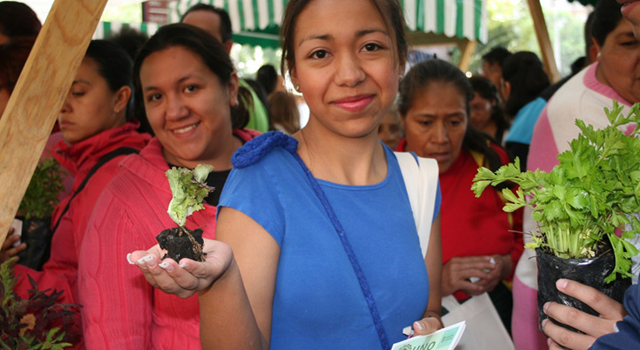
The city of Jundiai, Brazil, once struggled with litter-cluttered streets and trash-filled waterways. But 10 years ago, the city government launched a new program, called Delicious Recycling, designed to get more residents to recycle. In exchange for collecting cans and bottles, the city gives residents fresh produce grown in a local public garden. Now, the garden grows more than 30,000 plants to keep up with demand.

Other cities in Central and South America — particularly in Brazil — have similar programs. Curitiba, Brazil, began a recycling incentive program even earlier, offering transportation passes in exchange for recyclables. Residents of local shantytowns are employed to collect more trash, and the recyclable materials are sold to raise money for social services. The city now recycles 70 percent of its waste.

Inspired by the other programs, Mexico City is also now offering food in exchange for recycling.
The city has a major challenge with waste; it closed the largest landfill in the world last year, a 927-acre space that collected more than 76 million tons of trash. Now, the closed landfill will be tapped to generate power through its methane emissions. But every day, the city produces around 12,600 metric tons of new trash, and the government is looking for ways to dramatically cut that. The waste-to-food program is helping. When residents bring in their recycling, they’re given “green points” that can be spent at a local farmers’ market. It’s been a success so far, and the first market was so popular that all three tons of food were quickly given away.